Showing posts with label Cortinarius dyeings Seitikkivärjäys. Show all posts

Sunday, March 14, 2021

Cortinarius mushrooms and tannins in low pH Värjäys verihelttaseitikeillä ja tanniineilla happamassa liemessä

Catharine Ellis ja Joy Boytrup kirjassaan The Art and Science of Natural Dyes kertoivat menetelmästä, jossa joillakin luonnonväreillä voidaan värjätä tanniinin kanssa happamassa liemessä ja saada hyvinkin valonkestäviä värejä. Tämä värjäystapa sopii vain proteiinikuiduille eli lähinnä villalle. Tanniini sitoutuu kuituun hyvin ilman metallipuretusta ja auttaa myös muita väriaineita sitoutumaan siihen. Hapan liemi on oleellista tässä ja liemen pH pitäisi olla 3,5-4. Etikkaa voi käyttää alentamaan liemen pH:ta.  Värit tarttuvat hyvin, vaikkakin erilaisena kuin käytettäessä alunapuretusta, ja värien valonkeston pitäisi olla jopa parempi kuin alunapuretuksella, mutta toisaalta värien pesunkesto on heikompi, ja varsinkin kuumassa pesussa sidos väriaineiden ja kuidun välillä voi rikkoontua ja väriaine irrota, koska välissä ei ole metallipuretetta. Eli tämä värjäystapa ei sovellu usein pestäviin tuotteisiin, eikä näin värjättyä lankaa voi myöskään värjätä uudelleen ilman, että pohjaväri irtoaisi. Catharine Ellis on kirjoittanut kokeiluistaan blogissaan tänne.

Viime kesänä kokeilin ensimmäistä kertaa tätä tapaa verihelttaseitikeillä värjäämiseen. Veriheltta- ja veriseitikkien väriaineet ovat antrakinoneja. Tein väriliemen niin, että kaadoin kuivattujen sienten päälle kiehuvaa vettä, annoin hautua 5 min ja sitten siivilöin liemen. Toistin uuttamisen uudella puhtaalla kiehuvalla vedellä ja yhdistin siivilöidyt liemet. Kuivattuja lakkeja oli saman verran kuin lankaakin. Lisäsin liemeen aluna-viinikivipuretettua lankaa (no 8) ja lisäksi mallipätkät purettamatonta (no1), ja eri tanniinien lähteillä ilman muuta puretusta eli pujo (2), horsma (3), vadelmanlehdet (4), tammenkuorta (5), valkopajun kuori (6) ja tarajauhe (7).  Nämä langat olin tehnyt aiemmin viime kesänä tanniinikokeiluissani, täällä.

Tein kaksi värjäystä samalla tavalla, mutta erona oli se, että toisessa olin alentanut väriliemen pH:n 4 etikalla ja toisessa se oli pH 7.  Alla olevassa kuvassa ylempänä ovat näytelangat siitä liemestä missä pH oli 4 ja alempana näytelangat liemestä pH 7. Happamassa liemessä alunapuretettu lanka on hyvän punainen (no 8), ja purettamaton ja tanniiniesikäsitellyt langat olivat hiukan toisistaan eroavia vahvoja oranssinpunaisia. Alemmat neutraalissa liemessä olleet langat eivät ottaneet ollenkaan niin hyvin väriä poikkeuksena viimeisenä oleva aluna-viinikivipuretettu lanka, josta tuli hyvä hyvä vadelmanpunainen. Selkeästi näkyy se, että ilman puretusta tai tanniini-esikäsittelyllä liemen pitää olla hapan, jotta väri tarttuu, kun taas alunapuretuksen kanssa sillä ei ole niin väliä.

Pidin näitä lankoja elokuun lopussa kuistilla valossa osa peitettynä kaksi viikkoa, ja vaikka väriero ei näy kuvassa, niin purettamaton, pujo- ja horsmaesikäsitelty lanka haalistuivat hiukan, kun taas vadelmanlehti-, tammenkuori-, valkopajunkuori- ja tara-esikäsitelty lanka eivät haalistuneet juuri lainkaan eli tässäkin nyt näkyi, että jälkimmäisissä oli enemmän tanniineja. Täytyisi toistaa valonkestokoe nyt keväällä, elokuussa aurinko ei enää paistanut kovin hyvin.

IN ENGLISH

Catharine Ellis, Joy Boytrup book The Art and Science of Natural Dyes tells about an old method of dyeing where some natural dyes can be used with tannin and low pH without any metal mordant. This method is suitable only on protein fibers like wool. Tannins attach well to the fiber without any mordant, and help also other dyes to attach. pH of the bath should be low 3,5-4. Colours with this method are a bit different than when using a traditional metal mordant, but the light fastness should be even better than when using alum. However the washfastness is not as good as when using alum, and especially in hot water the bond between the dye and fiber can be broken. So this method is not good for work which needs to be washed often or the yarn can not be used for overdyeing. Catharine Ellis has written about her thoughts about this acid dyeing in her blog here.

Last summer I experimented for the first time this method to dye with mushroom Cortinarius semisanguineus. I extracted the dye from the dry caps of the mushrooms by pouring boiling water over the dry mushrooms, let them steep for 5 minutes and then strained the bath. I repeated the process and then combined the two extractions. I used the same amount of dry mushrooms as fiber. To the bath I added yarn mordanted with alum-cream of tartar (no 8), and also samples of yarn with no mordant (no1), and yarns dyed with different tannin bearing plants without any metal mordant. These were mugwort (no2), willow herb (3), raspberry leaves (4), oak bark (5), white willow bark (6) and tara (7). I have written about these dyeings here.

I did two experiments the same way, the only difference was that in the other the pH was 4 and in the other pH was 7. In the picture below the low pH samples are on top and the samples from neutral pH bath are in the bottom. Alum mordanted yarn (no8 in the top samples) is nice red, and in the same bath the samples with no mordant or tannin pre-treatment are quite strong orange-red. The yarns from the neutral bath in the bottom are not at all as strongly coloured, except the nethermost alum mordanted yarn which is nice raspberry red. So it is clearly visible how without mordant you need to have low pH to get good colour and with alum mordant the pH doesn't matter so much.

I made a small lightfastness test to these yarns in the end of August, but only for two weeks and there wasn't a lot of sun then. Still, there was some fading in the unmordanted yarn, and also mugwort and willow herb yarns, but not in other yarns, so that indicates that there wasn't enough tannins in mugwort and willow herb. I should repeat the test this spring when there is more sun. 


Loppusyksystä kokeilin samaa verihelttaseitikkien jaloilla. Kuivattuja sieniä oli saman verran kuin lankaa ja sieniä oli liotettu yön yli ja keitetty 30min ennen liemen siivilöintiä. Aluna-viinikivipuretettu lanka tuli heleämmän oranssiksi kun taas purettamaton ja tanniineillä esikäsitellyt langat ovat hiukan sameamman värisiä, mutta vahvoja värejä nekin. Väriliemen pH oli 4.

IN ENGLISH
Late last autumn I experimented with the stems of mushroom Cortinarius semisanguineus. I had the same amount of mushrooms as yarn. I soaked the dry mushrooms overnight, boiled them for half an hour before straining the bath. pH was lowered to 4 with vinegar like in previous experiment.  In the samples there is first yarn mordanted with alum and cream of tartar, then sample with no mordant, then raspberry leaf, oak bark, white willow bark and last tara. Tannin bearing samples became a bit darker than with alum or with no mordant.

Ellisin kirjan mukaan siis tämä menetelmä sopii vain väriaineille, joissa on antrakinoneja (mm krappi, kokenilli ja seitikit) tai naftokinonijohdannaisia (jalopähkinät ja henna), mutta EI flavonoideja sisältäville värikasveille (näitä ovat suurin osa kasveissa olevista keltaisista väriaineista), joiden keltainen väri tarvitsee metallipuretuksen tarttuakseen lankaan.  Kirjan mukaan tämä menetelmä on vanha ja Michel Garcian esille tuoma, ja siinä värjäys tehdään yhdellä kertaa niin, että väriliemeen lisätään tanniini ja sitten lasketaan pH ja sitten lisätään langat ja värjätään. Minä kokeilin nyt ensin esikäsitellyillä tanniinilangoilla, jotta saisin testattua kestot ja värisävyt. Muuten voisi varmaan tehdä tanniiniliemen ja väriliemen erikseen, yhdistää ne ja alentaa pH ja lisätä langat. 

Keltaisia antrakinoni-väriaineita löytyy kuitenkin paatsamankuorista ja raparperinjuuresta ja kokeilin  menetelmää paatsamankuorilla.

Kuivattuja paatsamankuoria oli 60g/100g lankaa, kuoria liotettu yön yli, keitetty tunti ja siivilöity. Väriliemen pH4, alennettu etikalla, värjäysaika tunti kuin edelläkin. Käytin tässä ja noissa aiemmissakin värjäyksissä hiukan enemmän väriainetta suhteessa lankaan kuin tavallisesti, ihan varmuuden vuoksi. Lopputuloksena hyvä keltaisia, joita ei yleensä saa ilman metallipuretusta, varsinkin jos noilla tanniini-esikäsitellyillä olisi parempi valonkesto kuin kokonaan purettamattomalla:).  Näistä en ole vielä kokeillut valonkestoa, mutta täytyy laittaa testiin kevään tultua.

IN ENGLISH

Ellis's book says this method is suitable only with dyes containing anthraquinones (madder, cochineal or also Cortinarius mushrooms have anthraquinones) or naphthoquinoid dyes (walnut hulls or henna), but NOT with flavonoid dyes which most of the yellow bearing plants are. They need a metal mordant to attach to the fiber. This is an old method and brought to attention by Michel Garcia, and usually done in only one bath using tannin powder, but I wanted to try with tannin pre-treated yarns to see what the colour would be and also to use our local tannins of which I already had samples.

Yellow anthraquinone dyes are in buckthorn bark and rhubarb roots, and I now also experimented with buckthorn bark. 

I have dry buckthorn bark 60g/100g fiber I soaked the dry barks overnight, boiled for one hour and strained the bath. pH of the dye bath was 4, lowered with vinegar, and dyeing time one hour. I used now in all these experiments a little more dye material than I would normally do, just in case. The result was nice yellows, and I hope the lightfastness is improved by tannin pre-treatment:). I will have to do a test for also these yarns in the spring.


Monday, December 16, 2019

December 16 One more Cortinarius colour Vielä yksi verihelttaseitikkiväri


Tänään värinä on vielä eilisestä verihelttaseitikkiliemestä saatu jälkiväri, kaupassa täällä.
Tätä väriä on hankala kuvailla, enkä tiedä miten hyvin onnistuin sen valokuvassakaan. Se ei ole kunnolla punainen, muttei oranssi tai ruskeakaan. Jotain oranssin ja marjapuuronvärisen sekoitukselta. Selvästi näkee, miten suurin osa väriaineista oli tarttunut jo ensimmäisessä värjäyksessä, mutta tämmöisiä vaaleampiakin värejä tarvitaan kyllä neuloessa, että saa kontrastia. Sienivärit sopivat tosi hyvin kaikki keskenään, kun taas osa niistä ei niin hyvin vaikka indigon kanssa.

Seitikkivärjäyksistä tuli mieleen, että olen varmaan joskus aiemminkin postannut linkin Riikka Räisäsen väitöskirjaan v 2002 Anthraquinones from the Fungus Dermocybe sanguines as Textile Dyes. Siellä on tosi paljon mielenkiintoista luettavaa seitikkien väriaineista ja värjäyksestä sekä värien kestoista. Riikka vetää myös nyt marraskuussa alkanutta projektia BioColour. Jännittävää aikanaan sitten kuulla projektin tuloksia.

IN ENGLISH
Today the yarn is still dyed with Cortinarius semisanguineus, in my shop here.
It was dyed in the after bath in the yesterday's yarn, so it is clear to see how most of the dyes had attached to the yarn already in the first bath. I think also these lighter colours are needed when knitting, to give contrast. In my eyes all mushroom dyed yarns go very well together, but not all with for instance indigo dyed yarns.

About Cortinarius dyeing: I may have posted already earlier a link to Helsinki University professor Riikka Räisänen's thesis from 2002 Anthraquinones from the Fungus Dermocybe sanguines as Textile Dyes. There is a lot of interesting read about the colorants in Cortinarius mushrooms and dyeing and fastness properties. Riikka is also a head of a project BioColour which started November this year. It will be exciting to read about the results of the project later.

Sunday, December 15, 2019

December 15 More Cortinarius semisanguineus Lisää verihelttaseitikkiväriä


Tämänkin päivän lanka on Velhoa, joka on värjätty verihelttaseitikkien lakeilla, kaupassa täällä.
Tämä on värjätty samalla tavalla kuin eilisen lanka, eli kiehuvaa vettä kuivien lakkien päälle, annetaan hautua 1-2 min, siivilöidään ja sitten toistetaan sama uudella puhtaalla kiehuvalla vedellä.
Lakkeja oli sama määrä kuin lankaakin. Ainoa ero eiliseen lankaan on, että nyt laitoin ensimmäiseen kiehuvaan veteen 1 rkl kidesoodaa/6l vettä ja kun mittasin, niin veden pH oli emäksistä pH9. Toisen uuton kiehuvaan veteen en lisännyt mitään ja meidän kaivoveden pH on siinä hiukan yli kuuden eli hapahkoa. Emäksinen uuttovesi joko irrotti punaisempia väriaineita, tai sitten muutti väriaineet sellaiseen muotoon, että vain punaiset tarttuivat esipuretettuun lankaan. Toisen uuton hapan vesi laimensi värilientä, ja lisäsin vielä kylmää tavallista vettä väriliemeen, ja ennen värjäystä liemen pH olikin 6-7 eli ei enää emäksistä, mutta silti värjäystulos oli punaisempi kuin eilisen kokonaan happamassa uutettu väri.
Monella värjärillä voi olla ihan luontaisestikin vesi neutraalia pH 7 tai ylikin kalkkipitoisilla mailla, ja tässä näkeekin miten paljon värjäyksessä tai uutossa käytetty vesi voi vaikuttaa lopputulokseen vaikka käytetyt sienet olivatkin ihan samoja, ja puretus sama.
Alla kuvassa vierekkäin vasemmalla tänään kuvatulla tavalla uutettu lanka ja oikealla eilen kuvattu lanka.

IN ENGLISH
Todays yarn is also Velho, which was dyed with dried Cortinarius semisaguineus caps, in my shop here.
This yarn was dyed the same way as yesterdays yarn: boiling water over dry mushrooms, steep for 1-2 minutes, strain and then repeat with fresh boiling water. There were the same amount of dry caps as yarn. The only difference to yesterdays yarn was that I now added one tablespoonful of washing soda to 6 litres of the first boiling water, so that the pH was 9 before I  poured it over the mushrooms. The second boiling water was without washing soda, our normal well water with pH little over six. The first alkaline water either extracted more red dyes from the mushrooms or changed them to such that only the red dyes attached to the yarn. When I dyed the premordanted yarn the bath was pH 6-7, that is slightly acid to neutral, because the second extraction was acid pH 6 and I also added more cold water to the bath to have enough volume to dye the yarns, and these diluted alkaline bath to more neutral.
Many dyer's may have neutral to slightly alkaline water to begin with and there is no need for them to use washing soda. Here it is clear to see how much impact water used in dyeing may have even when the used dye mushrooms were the same and mordanting was the same.
In the picture below there is on the left today's yarn and on the right yesterday's yarn which was extracted in ph 6.


Saturday, December 14, 2019

December 14 Cortinarius semisanguineus Verihelttaseitikki


Tämän päivän väri on tumma kuparinoranssi väri, kaupassani täällä.
Se on värjätty kuivatuilla verihelttaseitikkien lakeilla vaalean harmaalle Velho-langalle.
Yleensä värjään kuivatuilla sienillä niin, että ensin liotan sieniä yön yli, ja sitten haudutan (en keitä) tunnin verran, ja siivilöin ja värjään 60-70 asteessa tunnin. Tai liotuksen jälkeen laitan langat samaan liemeen sienten kanssa ja nostan lämmön n 60 asteeseen ja pidän siinä tunnin verran.
Nyt halusin kokeilla Jenny Deanilta oppimaani tapaa, millä uutetaan krapista väri, ja toimisiko se myös verihelttaseitikeillä.
En liottanut sieniä lainkaan etukäteen, vaan kaadoin kuivien sienten päälle kiehuvaa vettä ja annoin olla n 2minuuttia, jonka jälkeen siivilöin liemen. Toistin uuton samojen sienten kanssa ja kaadoin uuden puhtaan kiehuvan veden niiden päälle ja siivilöin taas  2 min kuluttua. Tuloksena oli hyvin tumma väriliemi, ja näytti siltä, että väriaineet olivat irronneet jo näinkin lyhyessä ajassa.
Käytin tähän värjäykseen saman verran kuivattuja sieniä mitä värjäyksessä oli lankaakin.
Lanka oli esipuretettua alunalla ja viinikivellä, ja värjäysaika tunti.

Menetelmä toimi loistavasti, ja säästi melko lailla aikaakin. Liemestä sai myös vaalean jälkivärin. Keitin vielä myöhemmin kahteen kertaan uutetut sienet nähdäkseni jos niistä irtoaisi vielä lisää väriä, ja kyllä niistä irtosikin, mutta selvästi suurin osa väriaineista oli jo irronnut lyhyissä uutoissa. Mielenkiintoista myös, että jälkiväristä ei tullut samanlaista oranssia, mitä yleensä saan, jos värjään aiemmin käyttämilläni tavoillani, vaan punertavampi.

IN ENGLISH
Todays yarn is copper orange, in my shop here.
It is dyed with dried Cortinarius semisanguineus caps on natural light grey 
Velho yarn base. 
I usually dye with those mushrooms first soaking them over night, and then simmering (not boiling) for an hour, straining, and then dyeing for an hour in 60-70°C. Or after soaking I put the yarns in the same bath with mushrooms, and start raising the temperature until it is 60°C and keep it there for an hour.
Now I wanted to try the Jenny Dean method I have used recently with madder, and see if it would also work with these dried mushrooms.
I didn't soak the dry mushrooms at all, but instead poured boiling water over them, and let them steep for only two minutes, and then strained the bath. I repeated the process with fresh boiling water on the same mushrooms. The result was very dark red bath, and it looked like the dyes had been released even after so short time.
I used the same amount of dry mushrooms as yarn, which was premordanted with alum and cream of tartar, and dyed the yarn in the bath for an hour.

The method worked brilliantly, and saved a lot of time. The same bath gave me also light second dye. I boiled the used mushrooms yet once more to see if they would release more colour, and they did, but clearly most of the dyes had been in the first two short extractions. Another interesting thing was to see, that afterbath gave me more reddish colour than orange, what I usually get when I extract the colour with my earlier methods.

Friday, December 13, 2019

December 13 Another Cortinarius dyed selection Toinen seitikkivärjätty lajitelma


Joulukuun kolmannentoista päivän langat ovat myös seitikeillä värjätty lajitelma, kaupassa täällä.
Näissä tummin väri on värjätty verihelttaseitikkien lakeilla, keskimmäinen hurmeseitikillä ja kellertävä punasuomuseitikeillä. Verihelttaseitikki on yleisin väriseitikeistä ja sillä värjäänkin kaikkein eniten. Hurmeseitikkejä löytyy hyvinä sienivuosina jonkin verran, mutta ei paljoa. Sen erottaminen veriheltoista voi aluksi olla vaikeaa, mutta kun niihin tottuu, niin ne kyllä ovat ihan erilaisia. Myös niiden väriainekoostumus on erilainen kuin verihelttaseitikeillä. Täällä olen kirjoittanut aiemmin hurmeseitikeillä värjäämisestä.
Punasuomuseitikki ei ole myöskään kovin yleinen, eikä se anna muille väriseitikeille tyypillisiä oransseja tai punaisia sävyjä vaan kellertävää. Täällä olen kirjoittanut sillä värjäämisestä. Punasuomuseitikin keltainen on vaaleampi ja rusehtavampi kuin eilisen tulihelttaseitikin keltainen.

IN ENGLISH
December 13th yarn is also a selection of oranges from mushrooms, in my shop here.
The darkest one is dyed with Cortinarius semisanguineus caps, the middle one with Cortinarius purpureus, and the yellowish one with Cortinarius  bolaris. C.semisanguineus is the most common dye mushroom in my area, and I dye with it quite a lot. I also have some of the dried caps in my shop.
In good mushroom autumns I can find some Cortinarius purpureus, but not a lot. At first it is difficult to tell apart from C.semisanguineus, but when you are used to it, they are distinct. Also the dye content in them is different from that of C.semisanguineus. I have written about dyeing with them here.
Cortinarius bolaris is not very common either, and it doesn't give oranges typical to other dye Cortinarius mushrooms, but more brown or yellow. Here I have written more about it. The yellow from C.bolaris here is more brownish yellow compared to yesterday's C.malicorus orange yellow.

Thursday, December 12, 2019

December 12 Cortinarius selection Lajitelma oransseja


Tänään lankoina on seitikeillä värjätty lajitelma oransseja, kaupassa täällä.
Näistä langoista alin eli tummin on värjätty hurmeseitikillä, Cortinarius purpureus, ja kaksi ylintä tulihelttaseitikeillä, Cortinarius malicorus. Tulihelttaseitikki kasvaa rehevissä kuusimetsissä, eikä kuivissa männiköissä, joita täällä meilläpäin on, eikä siis ole kovin yleinen täällä. Olenkin melkein joka vuosi saanut niitä pienen määrän sieniystävältä. Olen niillä värjännyt langat Oranssiin Tulppaani-lapaspakettiin, eikä niitä lankoja yleensä olekaan riittänyt myytäväksi muuten.

IN ENGLISH
Today's yarn is a selection of oranges, in my shop here.
They are dyed with mushrooms, and the darkest bottom one is dyed with Cortinarius purpureus, and middle and top one are dyed with Cortinarius malicorus. Cortinarius malicorus grows in moist and fertile spruce forests, not in dry pine forests which are more common near our place, and so I can't find it here, but I have a mushroom collecting friend who can find some of them almost every year.  I get a small amount from her, and I dye yarns in Orange Tulips mitten kit with this mushroom, so usually I don't have enough of those yarns to sell otherwise.

Sunday, October 20, 2019

Colours from autumn mushrooms Syksyn sienivärejä


Alkusyksy oli juuri sopivan sateinen sieniä ajatellen, vaikka kesä olikin kuiva.
Olen värjännyt samettijaloilla aika paljon varastoon tarvikepaketteja varten ja jotain samettijalkavihreitä riittää myyntiinkin.
Näitä lankoja on nyt myynnissä nettikaupassani.

IN ENGLISH
September and October have been rainy, which was good after a dry summer.
I have dyed a lot with Tapinella atrotomentosa olive green for the mitten kits, and also some yarns to sell.
I have now these mushroom dyed yarns in my online shop.


Ystäväni toi minulle taas yhden ison karhunkäävän, ja se olikin mahtava! Painoi jopa kaksi kiloa.
Karhunkääpiä ei ole paljoa, ja siksi olenkin tosi iloinen, että tuo yksi paikka tuottaa joka vuosi yhden tai kaksi kääpää:) Nyt se kääpä oli syyskuussa jo aika vanha, kuten kuvasta näkyy, mutta tuotti silti hyvin keltaista ja värjäsin sillä myös vihreää omilla väritattarilla värjättyjen sinisten päälle.

IN ENGLISH
I got one huge Dyer's Polypore, Phaeolus schweinitzii, from a friend. The weight of that one fungi was over 2 kilos. It is not a common polypore here, and that is why I'm so happy that this one place produces one or two polypores every year:). It was picked in September and was already a bit old, as you can see from the picture, but I still got yellows from it, and also green dyed on top of blue from my own japanese indigo.


Verihelttaseitikkejä on myös ollut aika mukavasti, paremmin kuin muutamaan viime vuoteen. Olen värjännyt niillä enimmäkseen tuoreena, mutta kuivannut myös osan. Ruskeat langat on värjätty harmaalle pohjavärille, mutta muuten normaalisti. Käytän aika paljon sieniä suhteessa lankaan, jotta saan vahvoja värejä (yleensä kilon tuoreita sieniä/100g lankaa). Jälkiväreistä tulee sitten oranssimpaa.

IN ENGLISH
I have also got quite nice amount of Cortinarius semisanguineus- mushrooms. 
I have dyed with them mostly fresh, but also dried some of them for later use. Brown yarns were dyed on natural grey base yarn. I use quite a lot of mushrooms (usually one kilo of fresh mushrooms to 100g of yarn), so that I get strong colours. After bath gives more orange colours.


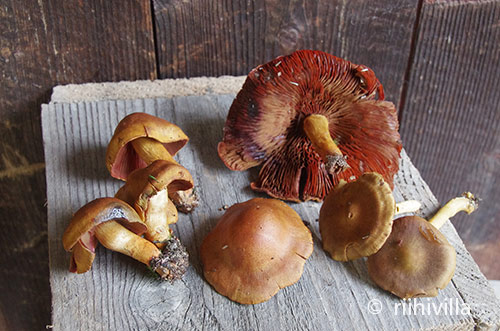
Ylläolevassa kuvassa on vasemmalla hurmeseitikkiä, Cortinarius purpureus, ja oikealla verihelttaseitikkiä, Cortinarius semisanguineus (tai siihen ryhmään kuuluvia seitikkejä). Pitkästä aikaa sain nyt hiukan hurmeseitikkejä, kun viime vuosina niitä ei ole ollut. Ei niitä nytkään tuon enempää ole, ja kuivasin ne myöhempää käyttöä varten. Niitä ei ole helppo erottaa veriheltoista, mutta ne ovat jykevämpiä sieniä, joilla on selvästi paksumpi jalka ja myös lakki. Kun verihelttaseitikin jalassa on punerrusta vain tyvessä, niin hurmeseitikillä on koko jalan pituudelta punaista häivettä (mikä ei kylläkään näy kuvassa kovin hyvin). Joskus hurmeseitikin jalka voi näyttää kokonaankin punaiselta.
Hurmeseitikissä ei ole ymmärtääkseni keltaisia väriaineita niinkuin veriheltoissa, vaan siitä tulee helpommin puhtaan punaista, eikä sen jälkiväreistäkään tule oransseja niinkuin verihelttojen jälkiväreistä, ainakaan minulla aiempien kokemusten mukaan. Löysin Outi Temmeksen Pro Gradu tutkielman Hurmeseitikistä värisienenä. Tosi mielenkiintoista. Siinä oli verrattua hurmeseitikkiä verihelttaseitikkiin värjäyssienenä, ja kokeiltu myös tanniinipuretusta ja värjäystä erikseen lakeilla ja jaloilla.

IN ENGLISH
In the picture above there are Cortinarius purpureus on the left and Cortinarius semisanguineus on the right. It has been several years since I got C.purpureus, autumns have been too dry for it, but now I  was happy to get some (only what is in the picture) and dried them for later use. They are not easy to tell apart from C.semisanguineus, but they are sturdier mushrooms on the whole, both caps and stems. While C.semisanguineus has red velum only in the base of the stem, C.purpureus stems are more reddish all the way (though it doesn's show well in the picture). Sometimes their stems may look all red.
As I understand there are no yellow colorants in C.purpureus like there are in C.semisanguineus, which make the afterbaths  of C.semisanguineus more orange yellow, and the after baths of C.purpureus give more pale reddish colour in my experience.
I found a Finnish study by Outi Temmes about dyeing with C.purpureus and comparing it to C.semisanguineus. Only the abstract is in English, and the whole of it in Finnish, but there are good pictures of the colours she got. She had also dyed separately with hats and stems as well as with whole mushrooms, and it was interesting to see that C.purpureus still gave yellow from the stems (with even slightly better fastness than from the whole mushroom).


Viime viikolla myös yhtenä aamuna suurin osa lehdistä oli pudonnut omenapuista, ja haravoin heti niitä talteen värjäystä varten. Yritän aina saada pudonneet puiden lehdet otettua heti putoamisen jälkeen, koska luulen, että jos ne likoavat sateessa, niin myös väriaineet huuhtoutuvat pois.
Syksyisistä lehdistä saa yhtä hyviä keltaisia kuin alkukesäisistäkin, mutta väri on niissä tiukemmassa jotenkin, ja lehtiä pitää liottaa pari viikkoa lievästi emäksisessä vedessä, että väri irtoaa.
Olen kokeillut parikin kertaa värjätä heti keruun jälkeen syksyllä, ja väristä on aina tullut vaaleampi kuin mitä siitä tulee jos antaa lehtien liota ämpärissä ensin. Laitan lehdet verkkopussiin ja sitten likoon, ja pussin kanssa ne on sitten helppo nostaa pataan värjäykseen, liotusliemen kanssa.
Mm täällä olen aiemmin kirjoittanut syksyn lehdillä värjäämisestä.
Näillä lehdillä värjään varmaan ensi viikon lopulla.

IN ENGLISH
One morning last week the wind had dropped all the leaves from apple trees, and I collected some right away for dyeing. If they get soaked in rain for days in ground, I think most of the dyes in them are gone, but when they are collected the same day, they are ok. I get as good yellows from autumn leaves as from summer leaves, but they need to be soaked in slightly alkaline water for two weeks for the dyes to come out. I have tried to extract and dye with them the same day when they were collected, but always I have gotten better results with a long soak with autumn leaves. I put the leaves in a net bag in a big bucket of water, with couple of table spoonfuls of washing soda, and leave outside. The net bags are easy to transfer to the pot to simmer, with soaking water.
Here I have written earlier about autumn leaves.
With these leaves I'm going to dye near the end of the month. 


Saturday, February 23, 2019

Recent Cortinarius colors Verihelttaseitikkivärejä viime viikolta


Tässä on erilaisia kuivatuilla verihelttaseitikeillä värjättyjä lankoja. Jos sienistä erottelee lakit ja jalat toisistaan tuoreina ja kuivaa ne erikseen, voi sitten myöhemmin värjätä eri sävyjä vaihtelemalla lakkien ja jalkojen suhdetta tai värjäämällä kokonaan erikseen kummallakin. Jaloista yksinään tulee kellanoranssia ja lakeista punaista/punaoranssia. Väriin vaikuttaa lisäksi moni muukin asia. Nuorilla tuoreilla verihelttaseitikeillä väristä tulee oranssimpi pelkillä lakeillakin värjättynä, kuin jos sienet ovat täysikokoisia ja vanhempia, ja kuivattuja. Värjäyslämpötila vaikuttaa tosi paljon saatavaan väriin, samoin kuin se ovatko sienet samassa liemessä lankojen kanssa vai ei. Kaikkein parhaita punaisia olen saanut 60°C lämpötilassa niin, että sienet ovat samassa lankojen kanssa. Sieniä vain liotetaan ennen värjäystä, ei keitetä. Korkeammassa lämpötilassa ruskeat ja keltaiset väriaineet vapautuvat/tarttuvat taas paremmin, ja silloin väristä tulee oranssimpaa. Myös vesi vaikuttaa. Vesijohtovedessä väristä voi tulla erilaista kuin kaivovedessä ja kaivoissakin on eroja.

Ylläolevissa langoissa kolme vasemmanpuolimmaista on värjätty niin, että sieniä on liotettu yön yli ja sitten keitetty tunti ja siivilöity, ja itse värjäyslämpötilakin on ollut 70-80°C. Vasemmanpuolimmaisimmassa oli lakkeja 75% ja jalkoja 25%, seuraavassa lakkeja 90% ja jalkoja 10%. Yllättävästi se näyttää kellertävämmältä vaikka jalkoja oli suhteessa vähemmän, mutta ehkä vaaleamman harmaa pohjaväri vaikuttaa. Kolmas eli keskimmäinen vyyhti on värjätty pelkästään lakeilla, samalla tavalla keiton ja siivilöinnin jälkeen. Se näyttääkin enemmän punaruskealta kuin nuo missä on ollut jalkoja mukana.

Keitin kertaalleen siivilöidyt sienet uudelleen parin päivän kuluttua (sienet olivat jo alkaneet hiukan haista!) uudessa vedessä ja värjäsin niillä, tuloksena nuo kaksi oikeanpuolimmaista vyyhtiä. Reunimmaisin on värjätty pelkistä lakeista tehdyllä liemellä, ja toisessa oikealta on sienet seoksesta, missä oli 10% jalkoja. Kuivattuja sieniä oli kussakin alunperin70g/100g lankaa, mutta noissa oikeanpuolimmaisissa, missä sienet oli keitetty toiseen kertaan, oli lankoja liemessä vain puolet alkuperäisestä määrästä. Kaikki langat olivat alunalla ja viinikivellä esipuretettuja. Selvästi näkee, miten sieniin oli vielä jäänyt paljon erityisesti punaisia väriaineita, vaikka ne oli keitetty kertaalleen. Keltaiset ja ruskeat väriaineet olivat liuenneet ensimmäisessä keitossa paremmin. Jos haluaa mahdollisimman voimakasta väriä, sienet kannattaakin keittää useampaan kertaan puhtaassa vedessä niin että kaikki väri irtoaa sienistä, ja sitten yhdistää liemet ennen värjäystä.

IN ENGLISH
Here is a picture of yarns I dyed recently with dried mushrooms Cortinarius semisanguineus. If you separate stems and caps after picking the mushrooms and dry them separately, you can later dye different shades by changing the ratio between caps and stems, or dye separately with either stems or caps. From stems alone you can get orange yellow, and from caps red/reddish orange/brownish orange. There are so many things that affect the resulting color. From young and fresh mushrooms the color is more orange than red, than from older specimen.  The best red comes when the mushrooms are frost bitten and very old, but then they are a bit difficult to dry. The extraction and dyeing temperature has big influence on the color, also whether the mushrooms are in the same bath with the yarns or not. I have gotten the best reds from these mushrooms when I have kept the temperature no more than 60°C, and the mushrooms are in the same bath with the yarns. I just soak the dried mushrooms before dyeing, I don't boil them. In higher temperatures the browns and yellows come out/attach better, and the color becomes more orange. I suspect also water may affect the color, and water from different well or town water may give different results.

The yarns in the picture were dyed so that the mushrooms were soaked overnight, then boiled for one hour and strained. The dyeing temperature was 70-80°C. The first yarn from the left had 75% caps and 25% stems, and the next one 90% caps and 10% stems. Surprisingly it looks more yellow orange, but it was dyed on lighter grey base yarn than the first, so that must be it. The third (the middle) skein was dyed with caps only (on grey yarn) and it is more reddish brown.

Then after couple of days I boiled the once used (and already a bit smelly!) mushrooms again in fresh water, and dyed with them. The result is the two skeins on the right. The one on the far right was dyed with the mushrooms left from the middle yarn dyeing, only caps. The second yarn from the right was dyed with bath made with mushrooms left from extraction with 10% stems (second from the left). Originally in the first baths I used 70% dry mushrooms/100g yarn, but after the second boiling I dyed only half the amount of yarn of the original, to get a stronger color. All yarns were premordanted with alum and cream of tartar. You can clearly see that there was still a lot of color left in the mushrooms even after the first boiling, and especially red color. Yellow and brown dyes were extracted better to the first boiling. If you want the strongest possible color, it is best to use multiple extractions of the mushrooms in fresh water (to get all the color out of mushrooms), and then combine the extractions before dyeing.

Saturday, July 21, 2018

About keeping dye baths Väriliemien säilytyksestä


Viime viikolla minulta kysyttiin, miten kauan väriliemiä voi säilyttää ja säilyvätkö ne hyvinä.
Mielestäni riippuu väriaineesta, miten kauan lientä voi säilyttää.
Krapin kanssa ei ole ongelmaa, ja kuuluu asiaan, että se alkaa käydä vaahdoten muutaman päivän kuluttua. Käyminen kestää ehkä viisi päivää, ja sen jälkeen liemi pysyy samanlaisena. Jos pinnalle näyttää muodostuvan hometta, lientä kannattaa sekoittaa, tai jos hometta näyttää tulevan enemmän, niin kuumentaa lientä välillä. Minulla ei koskaan ole ollut krappiliemen kanssa homeesta ongelmia, ja voin käyttää samaa lientä viikkoja. Käytettyjä krapinpaloja säilytän ämpärissä ja nekin säilyvät ulkolämpötilassa ihan hyvin käyttökelpoisina, jopa kuukausia. Jälkiväreistä tulee kuitenkin eri sävyistä kuin ensimmäisestä väristä, eli ruskeampaa. Voi olla, että veden laadulla on tässä myös merkitystä.

Erilaisia kuoria käytettäessä lientä voi säilyttää myös kuukausia ja se vain paranee vanhetessaan, mutta niiden kanssa liemeen kannattaa lisätä hiukan jotain emästä (pari ruokalusikallista ämpäriä kohti), kidesoodaa tai tuhkalipeää, koska muuten niihin voi tulla hometta, joka pilaa liemen.
Myös erilaisista vihreistä kasveista tehtyjä väriliemiä voi säilyttää useita viikkoja ja niissäkin useimmiten väri vain paranee. Ymmärtääkseni väriaineet muuttavat siellä liemessä muotoaan ja niitä tulee lisää liukoiseen muotoon, mutta myös tanniineja muuttuu liukoiseksi niissä.

Kokenilliliemi ei kestä säilytystä ehkä viikkoa pidempään vaan sen väriaineet hajoavat vähitellen jostain syystä. Käytetyt kokenillinpalat voi siivilöidä liemestä  pois ja kuivattaa, ja silloin niitä voi säilyttää ja käyttää uudelleen myöhemmin.

Myös seitikkiliemissä väri huononee liemen säilytyksessä, eli nekin kannattaa värjätä muutaman päivän sisään uutosta. Samettijalkalientä en ole kokeillut säilyttää, ja orakasliemethän taas paranevat säilytyksessä. Kääpäliemienkään säilytyksestä minulla ei ole paljoa kokemusta, yhden kerran ainakin taulakääpäliemi menetti väritehonsa kuukauden säilytyksessä, mutta en tiedä mistä se johtui.
Omista indigopitoisista kasveista uutettu liemi voi olla jopa parempi parin päivän kuluttua uutosta (ennen kuin siihen on lisätty pelkistävä aine), mutta sitten pidempiaikaisessa säilytyksessä liemi täytyisi saada pidettyä emäksisenä eli tiiviissä astiassa. Jos uutos pääsee neutraaliksi tai happamaksi, se voi mennä pilalle.

IN ENGLISH
Last week I was asked how long you can keep a dye bath.
I think it depends on the dye which you use.
With madder I have never had any problems and I have kept it for months. It is normal that after the first two or three days it starts to ferment if the temperature is kept low. Fermenting keeps going for maybe five days and then it stops and the bath seems to stay as it is. I have never had problems with madder bath getting mold, but I have heard it can happen. It is best to stir the bath from time to time and I think it may help. Also if mold starts to grow heating the bath stops it (take the moldy bits away first), After baths give different shade than the first bath, more brown, but water quality may also affect this.

Dye baths containing different barks can be kept for months, but it is best to add some alkaline (washing soda or wood ash lye) to them in the beginning to keep the mold from forming. And also many dyes release better in alkaline environment. Mold can ruin the bath.
Also baths made from many green plants can be kept at least a month and they get better, but adding alkaline also helps them I believe that dyes in the baths can convert to more soluble form during this time.

Cochineal bath doesn't keep well in my experience, and it is best used  in maybe a week from the start, but you can strain the used cochineal bugs from the bath and dry them and then they are ok to use later.

Baths from Cortinarius mushrooms don't keep well in my experience, and they are best to use withing a week from extraction. I can't say how Tapinella baths react to keeping, but tooth fungi baths only get better in time. I don't have experience about keeping self fungi baths, either. One time a bath from Fomes fomentarius was a month old and it didn't dye well after that time, but I'm not sure why.
Baths which I have made from my own grown indigo plants may even be better after a day or two after extraction (before I have added hydrosulfite), but if I'm keeping an extraction for a longer time, months, then I have to make sure it stays alkaline and the jar is air tight. Otherwise it may go bad.


Yllä kuva krappiliemestä kolmantena päivänä aloituksesta, käyminen on alkanut ja tästä ei pidä huolestua. Alla taas kuva vanhemmasta liemestä, jossa on jo toinen värjäys meneillään. Mielenkiintoista oli muuten, että viime viikolla noissa vierekkäisissä saaveissa tuossa vanhemmassa liemi oli viileämpää kun taas kovimman käymisen aikana toisessa saavissa liemi oli selvästi lämpimämpää kun sekoitin lankoja kädellä. Kohottiko käyminen liemen lämpötilaa? Ihan kuin näin olisi ollut, mutta voiko se olla mahdollista! En ollutkaan aiemmin kiinnittänyt tämmöiseen seikkaan huomiota.

IN ENGLISH
Above there is picture of a madder bath on day 3, fermenting has started.
In the picture below there is an older madder bath, and second yarns dyeing in it.

I noticed something interesting last week in these baths. They were side by side in my greenhouse in the same temperature, but when I stirred the baths with my hand, the fermenting bath felt clearly warmer than the older bath. Did the fermenting somehow warm up the bath temperature? It felt like it, but can it be possible! I haven't been aware of this earlier.


Saturday, September 30, 2017

Dyes from weld, sawwort and webcaps Värejä väriresedasta, liuskaläätteestä ja verihelttaseitikeistä


Syyskuu on mennyt yhdessä hujauksessa. Tässä on kuitenkin jotain värjäyksiä loppukesältä ja syksyltä.
Väriresedat (Reseda luteola) kasvoivat hyvin viileästä kesästä huolimatta ja heinäkuun lopulla alkoivat kasvattaa kukkavartta. Värireseda sisältää eniten väriaineita silloin kun 80% kukkavarsista on jo siemenvaiheessa ja juuri siemenkotia sisältävissä kukkavarsissa onkin eniten väriaineita. Myös lehdet kannattaa kerätä, mutta kaikkein paksuimmat varret jätän pois. Tänä kesänä väriresedat olivat valmiita kerättäväksi vasta syyskuussa ja allaoleva kuva onkin syyskuun toiselta viikolta. Väriresedan keltainen on hyvin kylmä keltainen, ja niitä kuluu minulla Kevät-lapaspakettiin. Vihertävämpi väri on värjätty harmaalle langalle. Jos haluaa väriresedasta kullankeltaista voi liemeen lisätä hiukan krappia, tai vaikkapa krapin jälkiliemiä. Käytin väriresedaa nyt 200g siemenvaiheessa olevia kukkavarsia ja lehtiä/100g lankaa.

IN ENGLISH
September has gone so fast. Here are some of my dyeings from past August and September.
Weld grew well in spite of cool summer, and in August it started to flower. The dye content in weld is the largest when 80% of flowers have gone to seed, and the flower stalks contain most of the dye. Also leaves have yellow dyes, but I don't use the thickest stems. This summer here my weld was ready to harvest in September, and the picture below is from the beginning of September. Yellow from weld is bright lemon yellow, I need it for the Spring Spirit -mitten kit. The greener yellow is dyed on naturally grey yarn. If I want more golden yellow from weld, I usually add a little bit of madder to the dye bath, or some of madder after bath liquid. I used now 200g of weld to 100g of yarn.


Aikaisemmin elokuussa värjäsin myös keltaista liuskaläätteillä (Serratula tinctoria). Nämä kasvit on kylvetty joitakin vuosia sitten ja viime vuonna värjäsin niillä ensimmäistä kertaa. Silloin keräsin lehdet kasvien ollessa nupulla, enkä saanut ollenkaan niin voimakasta väriä kuin tänä vuonna jolloin kasvit olivat jo osin siemenvaiheessa kun keräsin ne. Olinkin myöhemmin lukenut Luonnonväriaineet-kirjasta (Guinnot: Serratula tinctoria, a source of natural dye), että myös näissä on eniten väriaineita vasta kukinnan päätyttyä, ja kun tänä vuonna värjäsinkin näillä myöhemmin niin  sain hyvin voimakasta keltaista, eli liuskaläätteellä tosiaan kannattaa värjätä vasta loppukesästä. Eniten väriaineita siinä on lehdissä.
Sekä liuskalääte että värireseda sisältävät suhteellisen kestäviä flavonoideja kuten luteoliinia, mutta liuskalääte on siitä hyvä värikasvi, että se on monivuotinen ja kun sen kerran kylvää, niin satoa saa toisesta vuodesta eteenpäin jatkuvasti. Ainoa huono puoli mitä olen siitä huomannut on, että peurat syövät sitä mielellään, kun taas väriresedaa tai piiskuja ne eivät syö.
Kuva liuskaläätteellä värjätystä langasta alla. Käytin 500g tuoreita lehtiä/100g lankaa.

IN ENGLISH
Earlier in August I dyed also yellow with sawwort (Serratula tinctoria). I had sown these plants some years ago, and summer 2016 was the first time I dyed with my own plants. I harvested them when they were in bud and got only quite pale yellow, but this summer I got a much better and stronger colour when the plants were in seed stage when I harvested the leaves (and seed heads). I had read from Guinnot: Serratula tinctoria, a source of natural dye, that in sawwort  the flavonoid content is the largest in the end of the growing season, when the plants have finished flowering, and I did get a much better colour this year when I harvested the leaves later. Most of dyes are in the leaves.
Both weld and sawwort contain quite lightfast flavonoids like luteolin, and sawwort is a good dye plant for me also because it is perennial so I don't have to sow every year like I do with weld. The only negative thing about it is that deer seem to like to eat it, and they don't eat weld or goldenrods.
Picture of the yellow from sawwort is below. I used 500g of fresh leave to 100g of yarn.


Verihelttaseitikeillä värjääminen on juuri nyt ajankohtaista, alla kuvassa viime viikolla värjäykseen käytettyjä sieniä ja mitä niistä tuli. Käytän 1,5kg tuoreita sieniä (nyt kokonaisina)/100g lankaa ja tästä tuli ensin tuo kuvassa oleva tummempi punainen ja jälkivärinä oranssi. Näitä lankoja taas tarvitaan Syksyn hehku -lapaspakettiin.
Vaikka sienten keittämisessä liemi saa kiehua, niin jos haluan mahdollisimman punaista, niin itse väriliemen lämpötila kannattaa pitää n 70°C, tai ainakin alle 80°C. Kuumemmassa liemessä myös verihelttojen keltaiset väriaineet tarttuvat muuttaen värin enemmän ruosteenpunaiseksi. Kertaalleen keitetyt sienet voi keittää vielä toistamiseen, jolloin niistä irtoaa lisää väriä. Tai jos sieniä on vähän, niin ne voi keittää ensin kertaalleen, siivilöidä liemen, ja laittaa sienet uuteen puhtaaseen veteen ja keittää uudelleen, ja sitten yhdistää liemet. Minulla on sellainen tuntuma, että näin väriä irtoaisi enemmän. Että jotenkin veden määrä vaikuttaisi myös irtoavaan väriaineen määrään, siis että liemi kyllästyisi jotenkin helposti, mutta tämä on ihan arvelua ja mitään tutkimusta tästä en ole nähnyt. Myös sellainen huomio on, että sieniä ei kannata jättää väriliemeen jäähtymään yöksi kuten kasveilla monesti kannattaa tehdä. Minusta tuntuu, että tällöin osa väriaineista imeytyy takaisin sieniin. En tiedä onko muilla tämmöisiä kokemuksia?

IN ENGLISH
Last week I have dyed with mushrooms. In the picture below there are webcaps Cortinarius semisanguineus and what colour I got from them. I use 1,5kg of fresh mushrooms to 100g of yarn and from that amount I got first the darker red, and then orange in the after bath. I use these yarn in Autumn Fire -mitten kits.
Though I boil the mushrooms to extract the colour, I keep the dye bath with yarns in it below 80°C, preferably around 70°C (same as with madder). In the hotter bath also the yellow dyes from the mushrooms attach and change the resulting colour more rust red. Many times I also boil the mushrooms second time to extract more colour from them. Or I can extract the colour twice and then combine the baths to get a even stronger first bath. I have a feeling that combining several extractions from the same mushrooms I get more dye out the mushrooms, it is like the amount of fresh water matters, and the bath can get too saturated, but this is just  a feeling. Also I have noticed that unlike with most green plants (which benefit from long soaking) with mushrooms when I have boiled them, it is best to strain them right away and not let the bath cool with mushrooms in it. Somehow it seems like some of the dye could go back to to mushrooms if left to cool for overnight with mushrooms in it. I don't know if anyone else has the experience?


Saturday, February 18, 2017

The effect of iron on some dyes Rautapuretuksen vaikutus joihinkin väreihin

Tässä on muutamia näytteitä siitä, miten rautapuretus vaikuttaa verrattuna siihen onko rautapuretus tehty esipuretuksena vai väriliemeen jälkipuretuksena.
No 1 on purettamaton lanka
No 2 on purettamaton lanka, jonka väriliemeen on värjäyksen lopussa lisätty rautavihtrilliä 1% (1g/100g lankaa) 15 minutin ajaksi
No 3 on esipuretus 1 % rautavihtrillillä (esipuretus: purettamaton pesty lanka puhtaassa vedessä jonka lämpö on nostettu 80°C ja pidetty siinä ensin 45min, jonka jälkeen langat nostettu ylos ja lisätty veteen liotettu rautavihtrilli, ja laitettu langat uudelleen liemeen, jossa ne saivat olla 15 min. Langat on huuhdeltu kunnolla puretuksen jälkeen. Rautavihtrillillä esipuretettu lanka muuttuu kellertäväksi.)
No 4 on alunalla (10%) ja viinikivellä (5%) esipuretettu lanka
No 5 on alunalla (10%) ja viinikivellä (5%) esipuretettu lanka väriliemessä 1 tunti, jonka jälkeen liemeen on lisätty 1% rautavihtrilliä veteen liotettuna ja langat ovat edelleen saaneet olla liemessä 15 min.

Näytteet ovat olleet samassa kaikki väriliemessä, ja tunnin värjäyksen jälkeen 1,3 ja 4 on otettu pois ja no 2 ja no 5 jätetty liemeen vielä 15 minutiksi rautavihtrillilisäyksen jälkeen.

IN ENGLISH
Here are some samples to show how mordanting with iron affects the colour. The resulting colour is different when the mordanting is done as pre-mordanting, compared to when it is done as post-mordanting.
No1 is a yarn with no mordant
No 2 is a yarn with no mordant, but in the end of dyeing I have added 1% (1g/100g of yarn) of iron sulfate to the dye bath for 15 minutes.
No 3 is a yarn which was pre-mordanted with 1% iron sulfate (pre-mordanting: washed yarn is placed in clear water, and temperature raised to simmer (80°C), and kept there for 45minutes, after which time to yarns are taken out of the bath and iron sulfate added, and yarns are re-entered the bath, and kept there for 15 minutes. The yarns have been rinsed properly after mordanting). Iron pre-mordanted yarn is yellowish in colour.
No 4 is a yarn pre-mordanted with alum (10%) and cream of tartar (5%)
No 5 is a yarn pre-mordanted with alum (10%) and cream of tartar (5%), and after dyeing for one hour, the iron sulfate (1%) is added to the bath for 15 minutes.

The samples have all been in the same dye bath, and after dyeing for one hour, samples no 1,3 and 5 have been taken out of the bath, and no 2 and 5 have been left for another 15 minutes with added iron.

Krappi - Madder

Esipuretus raudalla muuttaa värin ruskeanvioletiksi, kun taas jälkipuretuksessa samaa värimuutosta ei tule vaikka rautapuretuksen kesto on sama 15 minuttia molemmissa.
Pre-mordanting with iron changes the colour to brownish purple while post-mordanting does not have the same effect, even though the time of the mordanting is the same 15 minutes.


Kokenilli - Cochineal

Myös kokenillin kanssa esipuretus raudalla antaa violettia väriä. Vaikka rauta-esipuretus oli tehty samalla kertaa kaikkiin näihin koevärjäyksiin ja huuhdeltu huolellisesti puretuksen jälkeen, niin kokenilli on niin herkkä raudan vaikutukseen, että esipuretetusta langasta väriliemeen nähtävästi irronnut hyvin pieni määrä riitti samentamaan myös muiden samassa kokenilliliemessä olleiden näytteiden väriä hiukan. Olen ennenkin huomannut, että kokenilli on hyvin herkkä raudan vaikutukselle. Krapin tai seitikkivärjäyksissä esipuretettu lanka ei vaikuttanut muiden samassa liemessä olevien lankojen väriin.

Also with cochineal iron pre-mordanting gives purple colour. Although I had used the yarn from the same pre-mordant bath to all these experiment, and tried to rinse the yarns well after mordanting, cochineal is so sensitive to iron, that even the very very slight amount of iron leached from the pre-mordanted yarns had affected to the colour of other samples in the same cochineal bath. I have noticed this earlier, too. Madder and mushrooms were not as sensitive to iron.


Verihelttaseitikki, lakit - Mushroom Cortinarius semisanguineus, caps


Verihelttaseitikki, jalat - Mushroom Cortinarius semisanguineus, stems

Tästä viimeisestä sarjasta täytyy sanoa, että tavallisesti saan verihelttaseitikkien jaloista keltaisempaa ja voimakkaampaa väriä, mutta nyt käytin vanhoja homehtuneita jalkoja ja selvästi se oli vaikuttanut myös väriin.
I usually get brighter and more yellow colour from the stems of this mushroom, but now I used old and moldy mushrooms and clearly mold had affected the colour. Anyway, you can see the effect of iron.


Wednesday, December 28, 2016

Cortinarius sanguineus Veriseitikkivärjäystä


Täällä lounaiskolkassa Suomea veriseitikki ei ole kovin yleinen. Metsät ovat enimmäkseen kuivia mäntykankaita ja jos veriseitikkiä löytääkin jostain notkosta, niin yleensä vain kourallisen. Vaikka veriseitikki sisältää paljon punaisia väriaineita, niin sieni on pieni ja ainakin minun kokemukseni mukaan sientä pitää olla aika paljon jos haluaa saada tummaa punaista. Vaaleita värejä saa pienemmälläkin määrällä. Verihelttaseitikkiä löytää yleensä enemmän ja sen lakeillakin saa hyviä tummiakin värejä kun vain lakkeja on tarpeeksi. Veriseitikkien ja verihelttaseitikkien väriaineet kuuluvat antrakinoneihin.

Yllä olevat langat on kuitenkin värjätty veriseitikeillä. Alkusyksystä sain ystävältäni kilon verran itä -Suomesta kerättyjä veriseitikkejä, jotka olivat jo hiukan mätiä kun sain ne. Näillä sienillä sain värjättyä 100g tuota tumminta punaista, josta tulikin yllättävän tumma, ja kaksinkertaisen määrän alinta vaaleampaa punaista. Vaaleita jälkivärejä olisi varmaan tullut lisää, mutta vaaleat värit eivät myy kovin hyvin, joten en useinkaan värjää niitä. Niiden valonkestokaan ei ole yhtä hyvä kuin tummilla väreillä.
Keskimmäinen punainen on värjätty nyt joulukuussa kuivilla veriseitikeillä, suhteella 100g kuivia sieniä/100g lankaa. Kaikki langat ovat olleet esipuretettu alunalla ja viinikivellä, ja sienet ovat saaneet kiehua tunnin ennen siivilöintiä välittömästi keiton jälkeen. Värjäyslämpötila on ollut 60-70C, minkä olen huomannut antavan punaisemman värin kuin mikäli liemi olisi kuumempi.
Olin ajatellut, että kilosta tuoreita tulee noin 100g kuivattuja sieniä, mutta jostain syystä kuivatuilla en saanut yhtä voimakasta väriä kuin tuoreilla. Hyvän  värin kuitenkin ja vaaleamman jälkivärin myös. Epäilen, että syynä oli ehkä se, että tuoreet olivat osittain mädäntyneitä ja monesti veriheltoillakin vanhoilla sienillä tulee voimakkaampi väri kuin ihan nuorilla ja hyväkuntoisilla. Ehkä kasvupaikkakin voi vaikuttaa ja lisäksi veriseitikistä on olemassa kaksi eri lajia (veriseitikki, Cortinarius sanguineus ja palttuseitikki, Cortinarius vitiosus), lajit ovat hyvin toistensa näköisiä, enkä osaa sanoa kumpaan nämä saamani sienet kuuluivat, mutta veriseitikki yleisempänä on todennäköisempi. Palttuseitikki sisältää Luonnonväriaineet-kirjan mukaan vähemmän keltaista antrakinonia emodiinia, joten siitä saatava väri on punaisempi kuin veriseitikistä. Mycologia -lehdessä (2012) on englanninkielinen artikkeli näistä sienistä: Niskanen, Laine ja Liimatainen: Cortinarius sanguineus and equally red species in Europe with an emphasis on northern European material.

IN ENGLISH
Here in south western Finland mushroom Cortinarius sanguineus is not common. Forests are mainly dry pine forests, and I can find only a handful of this mushroom, if even that. They grow more in middle or east of Finland in more moist forests. Though it contains a good proportion of dye in it, it is a very small mushroom and at least my experience is that to get dark good reds you need a lot of mushrooms. For lighter colors smaller amounts is enough. Cortinarius semisanguineus which is more common here is a close relative to C.sanguineus. Caps of C.semisanguineus are a better source of mushroom reds for me because they are more abundant and it is a bigger mushroom (though not very big). Both of these Cortinarius mushrooms contain anthraquinone dyes.

However, these yarns are dyed with C.sanguineus. 
In early September I got about one kilo of fresh mushrooms from a friend who had collected them in eastern Finland. They were already a little rotten when I got them and I dyed 100g of yarn with them and got the top color in the picture. Quite nice dark red. The after bath gave me 200grams of the bottom color, and possibly I would have gotten also more lighter colours but I don't dye a lot of pale colours because they don't sell well. Dark colors are always sold  fast:)
The yarn in the middle was dyed just before Christmas with dried C.semisanguineus, and it is also a nice red.  I used 100grams of dried mushrooms to 100 grams of yarn.  All yarns were mordanted with alum and cream of tartar. Mushrooms were boiled for one hour and strained right after boiling. The temperature in the dye bath with yarns was 60-70C, which I have found gives better colors than simmering.  These yarns are now in my shop.
I would have thought that a kilo of fresh mushrooms becomes about 100grams of dried mushrooms, but for some reason I didn't get as dark color now with dried mushrooms as I got with fresh ones.  I suspect that one reason for this may be that the fresh mushrooms were very old and partly rotten. I have noticed previously that old Cortinarius mushrooms give better reds than young specimen which give more orange, and have more yellow dyes in them and less reds, so this might be the reason now, too. Also, in recent studies Cortinarius sanguineus has been split to two different species: C.sanguineus and C.vitiosus, which are quite similar. I don't know which ones I had, though C.sanguineus is more likely. C.vitiosus is not so common, and according to book Luonnonväriaineet by Räisänen, Primetta and Niinimäki, it doesn't contain emodin like C.sanguineus so the color it would give could be more red. There is an article  about these mushrooms (not dye wise) in Mycologia (2012): Cortinarius sanguineus and equally red species in Europe with an emphasis on northern European material written by Niskanen, Laine and Liimatainen.

Wednesday, June 11, 2014

More dyeing in the spring Lisää keväisiä värjäyksiä


Siivoilin keväällä taas varastoja ja löysin muutamia säkillisiä kuivattuja pajun ja lepän lehtiä ulkovarastosta. Lehdet olivat tosi vanhoja, varmaan ainakin 15 vuotta vanhoja, ja kun ne olivat paperisäkeissä ne olivat ottaneet kosteutta ja homehtuneet. Ajattelin silti kokeilla tulisiko niistä mitään ennen kuin heitän ne kompostiin. Käytin kuivattuja lehtiä 200g/100g lankaa. Liotin lehtiä ensin pari viikkoa lievästi emäksisessä vedessä, keitin ja siivilöin liemen. Pajun lehdistä tulikin ihan hyvä keltainen/kellanruskea (langat esipuretettu alunalla ja viinikivellä), tuo voimakkaampi väri alla olevassa kuvassa. Samanlaisista homehtuneista lepänlehdistä ei kuitenkaan tullut juuri lainkaan väriä, se on tuo vaaleampi samassa kuvassa. Yllättävän hyvin nuo pajunlehdet olivat säilyttäneet väriaineet itsessään vaikka ne olivatkin niin vanhoja ja lisäksi vielä homeisia.

IN ENGLISH
I was cleaning my storage shed in the spring and found some bags of dried leaves of willow and alder. They were very old, at least 15 years old, and since they were stored in paper bags they had gotten moldy. I wanted to try if they yield any color before I throw them in the compost.
I used 200 grams of dried leaves to 100 grams of yarn. I soaked the leaves first for two weeks in slightly alkaline water, simmered them and strained the bath. The willow leaves gave a nice quite strong brownish yellow (the yarns were mordanted with alum and cream of tartar), it is the stronger color in the picture below. The same kind of moldy alder leaves didn't give much color, it is the paler yarn in the same picture. It was surprising how well the willow leaves had contained the dyestuffs, even though they were so old and moldy.


Minulla oli myös vähän homeisiksi päässeitä kuivattuja verihelttaseitikkien lakkeja, ja niistäkin tuli ihan hyvin väriä, homeesta huolimatta. Tässä on ollut 50g kuivattuja sieniä/100g lankaa.

IN ENGLISH
I had also some dried caps of Cortinarius semisanguineus mushrooms which had gotten moldy, and they also gave color despite the mold. I had used 50grams of dried mushroom to 100grams of yarn.


Löysin myös ämpärin missä oli viime vuonna aurinkovärjäyksessä olleita käytettyjä raparperinjuuria ja kokenillia, mössö oli värjääntynyt punaiseksi, mutta keitosta huolimatta näistä ei irronnut mitään väriä enää lankoihin. Ne olisi siis kannattanut syksyllä heittää suoraan kompostiin ja täytyy muistaa jatkossa näiden väriaineiden kanssa, että niillä pitää värjätä jälkivärit heti saman tien. Minulla on sellainen mielikuva, ettei kokenilli muutenkaan kestä pitkää säilytystä kosteana tai liemenä. Kuivattuna se kyllä säilyy.

Yhdessä pussissa oli myös viime vuotisia kuivattuja sekalaisia orakkaita (varmaankin oranssiorakkaita enimmäkseen). Muistelin niiden olleen hyvin nuoria ja siksi ne olivat jääneet laittamatta varastoon tai värjäämättä syksyllä ja kun nyt kokeilin niin eipä niistä tullut juuri mitään väriä, emäksisestä liemestä ja pitkästä keitosta huolimatta.

IN ENGLISH
I also had a bucket where I had kept left over rhubarb roots and cochineal, which I had used for solar dyeing last year. They looked still good and red, but I got practically no color to the yarns. I have to remember to either use them again right after solar dyeing if I want more color from them, or just throw the used dyestuffs to the compost. I think cochineal doesn't store well wet or as bath anyway, but of course it stores well when dry.

Another dye dud was a bag of mixed dry tooth fungi (mostly Hydnellum aurantiacum) which I remember being collected too young and that is why I didn't use them last autumn and they were left laying around. Anyway I boiled them in alkaline bath, but never got any good color from them.


Nyt sitten ovat jo taas kesävärjäykset tuoreilla kasveilla alkaneet, ja indigopata on käytössä. Kasvihuoneessa on krappivärjäys saavissa ja se toimii hyvin näillä helteillä.

IN ENGLISH
Now I have already started the summer dyeing with fresh plants, and set up my indigo pot outside.
In the greenhouse I have madder in a big tub with yarns and it works well now that the days are warm.


Thursday, April 4, 2013

Dyeing with Cortinarius bolaris Värjäys punasuomuseitikillä


Oudommista väriseitikeistä minulla oli myös ystävältäni saatuja punasuomuseitikkejä (Cortinarius bolaris), itse en ole sitä koskaan löytänyt. Mm täällä ja täällä on siitä kuvia.
Ei tiedetä tarkkaan mitä väriaineita punasuomuseitikki sisältää, Lundmarkin sienivärjäyskirjan mukaan ne eivät kuitenkaan ole antrakinoneja kuten  Dermocybe-suvun väriseitikeillä.
Lundmarkin mukaan siitä pitäisi alunapuretuksella saada ruskeaa, toisaalta amerikkalaisen Bessetten kirja sanoo, että siitä pitäisi tulla kellanruskeaa ja purettamattomaan pinkinruskeaa.

Nyt minulla oli kuivattuja sieniä 100g, liotin ne yön yli ja keitin sieniä tunnin. Liemi oli ihan rubiininpunaista, todella hienon väristä. Annoin sienten olla liemessä ja lisäsin sinne 100g aluna (10%) -viinikivipuretettua (5%) lankaa ja värjäsin tunnin. Samaan liemeen laitoin mallipätkät purettamattomasta langasta, sekä langoista, jotka oli värjätty ilman puretusta tammenkuorilla ja toinen raparperinlehdillä ( 4 x tuoreita lehtiä suhteessa langan painoon, värjätty 15.6.2012) eli ns tammenkuoripuretus ja raparperipuretus.
Pettymyksekseni väristä tuli kellanruskeaa, ei ollenkaan mitään hienoa tummanruskeaa, kuten vaikkapa oli saatu täällä. Purettamattomassa ja tammenkuorilangassa punertava väri tuli esille, mutta hyvin heikkona.
Koska liemi näytti edelleen hyvin vahvan punaiselta, värjäsin sillä vielä kaksi jälkiväriä, joista tuli vähemmän keltaisia kuin ensimmäisestä, mutta siltikään punainen tai ruskea väri ei tarttunut lankoihin.
Vaikka käytin kaksi kertaa enemmän sieniä, mitä Lundmarkin kirjassa, niin väristä tuli vaaleampi. Ehkäpä tämä väri tarttuisi paremmin teollisiin superwash-käisteltyihin lankoihin. Eli tämän kokemuksen jälkeenen ole kovin innostunut tästä sienestä, varsinkin kun se ei ole kovin yleinenkään. Muilla seitikeillä saa samoilla suhteilla paljon voimakkaampia värejä. Toisaalta olisi kyllä mielenkiintoista tietää mitä väriaineita liemessä olevat punaiset ovat ja miten ne saisi tarttumaan lankaan!
1. esipuretus aluna-viinikivi
2. purettamaton
3. ns. tammenkuoripuretus
4. ns. raparperinlehtipuretus
5. 1. jälkiväri, esipuretus aluna-viinikivi
6. 2. jälkiväri, esipuretus aluna- viinikivi

IN ENGLISH
My friend had found me some Cortinarius bolaris mushrooms to try for dyeing. I have never found it, but here and here are pictures of it and here in English.
According to Swedish Lundmark's mushroom dye book, the dyestuffs in this mushrooms are unknown, they are not anthraquinones like in dye mushrooms belonging to Dermocybe group..
Lundmark says that this mushroom gives brown with alum, Bessette's book says it give yellow-brown with alum and pinkish brown with no mordant.

I had now 100grams of dry mushrooms, I soaked them overnight, then boiled them for one hour. The bath was really brilliant rubin red, so it looked promising. After cooling I left the mushrooms in the bath and added 100grams of wool mordanted with alum (10%) and Cream of Tartar (5%). I also added small pieces of unmordanted wool, and wool dyed with oak bark (no mordant) and another dyed with rhubarb leaves (no mordant), 4 times the rhubarb leaves to the weight of the wool, dyed June 15th 2012.

After dyeing one hour to my disappointment, the color on alum mordanted wool was not dark brown, like here, but instead dull yellow-brown. On unmordanted and oak bark "mordanted" wool the reds in the bath showed, but only very pale. Because the bath still looked bright dark red, I dyed two after colors. Even though I used twice as much dried mushrooms as Lundmark's books say, I still got paler colors than in her book. Perhaps these colors attach better on industrial superwash treated yarns, like some colors do. So after this experience I'm not so excited about this mushroom, especially when it is not so abundant here. I get much better colors with other Cortinarius mushrooms. On the other hand it would be interesting to know what are the dyestuffs in the red bath, and how to get them to attach to the wool.
Samples in the picture:
1. Premordanted with alum and Cream of Tartar
2. unmordanted
3. "oak-bark -mordanted"
4. "rhubarb leaf-mordanted"
5. 1st after bath, premordant alum and Cream of Tartar
6. 2nd after bath, premordant alum and Cream of Tartar

Saturday, March 30, 2013

Dyeing with Cortinarius purpureus Värjäys hurmeseitikillä


Seuraava sienivärjäys kuivatuilla sienillä oli hurmeseitikeillä (Cortinarius purpureus, syn Cortinarius phoeniceus).
Hurmeseitikki on hyvin samanoloinen sieni kuin verihelttaseitikkikin, mutta hiukan harvinaisempi. Se kasvaa rehevissä havumetsissä, rehevimmillä paikoilla nähtävästi kuin verihelttaseitikki, ja mm nämä sienet kasvoivat vanhan muurahaispesän ympärillä, minne oli kertynyt paksu kerros havuneulaskariketta.

IN ENGLISH
Next I dyed with dried Cortinarius purpureus (syn. Cortinarius phoeniceus).
It is very similar looking webcap as more common Cortinarius semisanguineus, and grows here in rich spruce forests. Apparently it craves more rich soil than C.semisanguineus, and the mushrooms in these pictures were growing around an old and big anthill, where there was a thick layer of needles on the ground.


Hurmeseitikki on yleensä isokokoinen, paksumaltoinen ja tukevamman oloinen kuin verihelttaseitikki. Vaikutelma tulee siitä, että sen jalka on paksumpi ja lyhyempi suhteessa lakkiin kuin verihelttaseitikin jalka. Yllä ja alapuolella olevissa kuvissa oikeassa reunassa on vertailuksi kaksi verihelttaseitikkiä ja erot jaloissa näkyvät selvästi. Myös lakin värityksessä on usein eroa. Tärkein ero on kuitenkin yleishabituksen lisäksi jalassa: verihelttaseitikin jalka on vaalean keltainen, sillä on vain jalan tyvessä punaista, kun taas hurmeseitikin koko jalassa on punaista häivemäistä seittiä, mikä tekee jalasta punertavamman näköisen.
Näiden sienten kanssa erot ovat suhteellisia, ja ennenkuin on löytänyt hurmeseitikkiä, sitä katsoo jokaista seitikkiä, että onkohan tämä nyt se, mutta kun sitten löytää oikean hurmeseitikin, niin kyllä sen heti erottaa verihelttaseitikeistä, ja sen jälkeen erottaminen on helpompaa:).

IN ENGLISH
Cortinarius purpureus is usually big webcap, and it has thick flesh and looks sturdier than C.semisanguineus. Sturdy impression comes from shorter and thicker stem in C.purpureus compared to the stem of C.semisanguineus. In the pictures above and below there are two C.semisanguineus  on the right , and you can see the difference in the stems. Also the color of the cap may be different. The most important difference, added to the over all habitus, is the stem. C.semisanguineus stem is slim, pale yellow with red velum only at the base of the stem, while C.purpureus has web-like red on the whole stem, which gives it redder impression.
These differences are relative, so they are difficult when you haven't yet found both of these mushroom, but when you find C.purpureus for the first time, you can immediately see, that it is something else than C.semisanguineus:).


Hurmeseitikin väriaineet ovat pääasiassa punaisia, dermocybiiniä ja sen glukosideja, ja siksi  sillä värjätessä jälkiväristä ei tulekaan sellaista oranssia tai keltaista kuin muilla tavallisilla seitikeillä tai veriseitikillä. Toisaalta Lundmarkin kirja sanoo, että erityisesti hurmeseitikin jälkiväreillä valonkesto on huonompi kuin muiden seitikkien väreillä. Tästä syystä käytinkin nyt aika paljon sieniä suhteessa lankaan eli 100g kuivattuja sieniä sataa grammaa lankaa kohti. Sieniä oli liotettu yön yli, haudutettu tunti ja sitten lisäsin jäähtyneeseen väriliemeen alunalla ja viinikivellä esipuretetut langat. Sienet olivat samassa liemessä koko värjäyksen ajan, ja tästä syystä väristä tuli hiukan epätasaista, mutta varsinkin ensimmäinen karmiininpunainen on ihan hieno väri. Nyt vaan pitää sitten odottaa taas uutta hyvää seitikkivuotta.

IN ENGLISH
The dyestuffs in Cortinarius purpureus are mainly reds, dermocybin and it's glucosides, and that is why the after bath of C.purpureus from less orange or yellow than when dyeing with other webcaps. On the other hand Swedish Lundmarks's book says that particularly the after baths from this mushroom are not as lightfast as the after baths from other Cortinarius mushrooms. 
That is why I used now a lot of mushrooms: 100g of dried C.purpureus to 100grams of yarn. I soaked the mushroom over night, then simmered for one hour, and after cooling the bath, added the mordanted fiber. The mushrooms were in the same bath with the fiber during the dyeing, and this is why the color is slightly uneven (the parts of the fiber which touched the mushrooms got more color), but I think the darker color from the first bath is really nice. Now I have to wait for the next good mushroom autumn to get more of these.