Sunday, May 26, 2013

Planting japanese indigo Väritattaren istuttamista


Tavallisesti istutan väritattaren vasta kesäkuussa, samaan aikaan kuin kesäkurpitsan ja muut hallanarat vihannekset, mutta nyt säätiedotus lupaa ensi ja seuraavaksi viikoksi niin lämmintä, että otin riskin ja aloin istuttaa väritattaria ulos jo tänään. Samalla saan tilaa kasvihuoneeseenkin. Toivottavasti ennusteet pitävät paikkansa eikä halloja tulisi enää.

Puutarhassani minulla ei ole mitään isoa peltoa käytettävissä, vaan hyötykasvipenkit ovat hajallaan perennojen ja muun puutarhan väleissä. Kasvihuoneen seinustalle mahtui yksi laatikollinen taimia, loput pääsevät ns. varamaalle, josta vähitellen otan pois perennojen ja pionien taimet pois ja muutan sen kokonaan värikasvien käyttöön. Ainakin tämmöinen olisi tarkoitus.
Seinustan penkki oli muokattu jo toukokuun alussa, ja siihen oli lisätty lantakompostia, minkä jälkeen olin peittänyt penkin lehti- ja ruohosilpulla. Nyt istuttaminen oli helppoa ja maa sopivan kosteaa katteen alla, vaikka täällä ei ole satanut juuri lainkaan koko toukokuussa.

IN ENGLISH
Usually I start to plant tender vegetable plants and japanese indigo plants outside in June, when it is certain that there are no frosts any more, but now the 10 day weather forecast gives such promising high temperatures, that I took a risk and started to plant my japanese indigo outside today. So then I also get more room to plant things inside the greenhouse, too.

In my garden I don't have a big open field, instead I have several smaller beds and perennials growing around. By my greenhouse, I have one bed and I planted there some of the japanese indigo plants. Most of them are going to be planted this year in my so called spare beds, where I have had perennial plants and peony seedlings, which I have now moved away to their proper place, and it will become a place only for dye plants. At least that is the plan.
The bed by the greenhouse was turned in early May, and we added then horse manure compost, and after that I covered the bed with dry leaf and grass clippings and it was ready and waiting for the plants. Now planting was easy and the soil was just the right moisture under the mulch even though we haven't had hardly any rain in all May.


Väritattaren taimet ovat kyllä jo ihan sopivan kokoisia istutukseen ja niillä oli hyvä juuret paakuissa.
Varamaan maa laitettiin kuntoon taimia varten vasta tänään, joten siellä ei ole vielä katetta maan pinnalla.

IN ENGLISH
Japanese indigo plants were big enough for transplanting, and they had good roots.
The spare beds were prepared for planting today, so there is no mulch yet.


Vielä jäi istutettavaa huomiseksi (alkoi sataa), yhteensä laitan nyt n 170 tainta väritatarta ja sitten elo- ja syyskuulla pääsen värjäämään sinistä ensi talven varalle. Eihän se ole kovin paljoa, mutta toivottavasti riittää, koska väritatar on niin satoisa ja antaa paljon väriä.
Peitin istutetut taimet kasvuharsolla, joka saa olla niiden päällä juhannukseen saakka, ja myöhemmin ensi viikolla katan taimien välit ruohosilpulla.

IN ENGLISH
I have still planting to do tomorrow (it started to rain), I have total of about 170 plants of japanese indigo this year. Not very much, but I hope enough for the blue dyeings in August and September for the blue yarn I need for the winter, japanese indigo is such a good plant for indigo. 
The plants are covered by horticultural fleece now and I will mulch them with grass clippings later.


Istutin muutaman isoimman taimen myös kasvihuoneeseen, viiniköynnäksen alle, ja toivon näiden ehtivän tehdä kukkia kasvihuoneessa, jotta sitten saisin niistä siemeniä syksyllä.

IN ENGLISH
I also planted the biggest plants inside the greenhouse, under my grapewine, and I hope that these plants will start to flower earlier and I would get seeds from them in the autumn.

Sunday, May 19, 2013

What's happening Kuulumisia


Kevät meni nopeasti ohi. Viimeiset valkovuokot kukkivat ja lehti on tullut puihin viime viikolla.
Meidän piti aloittaa torikausi jo ensi viikolla, mutta auto on reistaillut ja niinpä arkipäivät torilla alkavat vasta kuun vaihteessa ja kesäkuusta lähtien mieheni on taas Helsingissä Kauppatorilla 3-5 päivää viikossa, myyntipäivien painottuessa niihin päiviin, jolloin Helsinkiin tulee isoja risteilijä-laivoja, ja paljon turisteja. Ilmoitan aina kunkin viikon myyntipäivät tänne blogin sivupalkkiin viikon alussa.
Minä olen aloittanut kesän puretuksia ja värjäyksiä ja teen lisää myytävää torille, lankoja, tarikepaketteja, pipoja yms. Tälle kesälle en ole ajatellut mitään erityisiä värjäyskokeiluja, vaan keskityn tuohon torimyyntiin, ja siihen, että siellä olisi tarpeeksi myytävää:) Päivityksiä värjäyskasvien osalta kyllä tulee blogiin, ja jos jotain muuta mielenkiintoista tulee mieleen.

IN ENGLISH
Spring went past so fast this year, now the temperature is like in the summer. Last of the wood anemones are still flowering and trees have leaves now. 
We were meant to start the market season next week, but we're having car trouble, so the week days at the market start near the end of May. During summer my husband will be at the market 3-5 days a week, depending on when the big cruise ships come to Helsinki and bring lots of tourists. I will post the market days in the beginning of each week here in the sidebar of my blog.
I have mordanted  yarn for the summer dyeings, and also started to dye more now, and mostly  I concentrate on trying to have enough dyed yarns, kits and knitted things for the market for my husband to sell, so I haven't planned any dyeing experiments for the summer. I will post updates on my dyeplants, and if anything special comes to mind:)


Talvehtineet morsingo työntävät kukkavartta, nämä kasvavat sitten nopeasti, kun vertaa viime postauksen kuvaan pari viikkoa sitten.

IN ENGLISH
My second year woad is  bolting now, and soon flowering. These grow so fast, when you compare the picture to the one I posted two weeks ago of the same plants.


Väritattaren taimet ovat vielä kasvihuoneessa, näitä ei uskalla istuttaa ulos ennenkuin kesäkuussa, koska ne ovat niin hallanarkoja, ja vaikka nyt on lämmintä, niin vielä voi tulla hyvinkin kylmiä öitä.

IN ENGLISH
Japanese indigo seedlings  are growing well, they are in the greenhouse. Even though it is now warm, I will wait until the beginning of June before I plant them outside, the cold nights are still very likely, and japanese indigo is very tender in the spring. 

Sunday, May 5, 2013

Woad Morsinko


Viime syksynä jätin leikkaamatta kaksi morsinkoa ja ne ovat talvehtineet parhaiten. Ruusukkeet paljastuivat vihreinä lumen sulettua ja nyt on jo keskellä uusia lehtiä tulossa. Jos kaikki menee hyvin, niin ne kukkivat kunnolla ja saan niistä paljon uusia siemeniä.

IN ENGLISH
Last autumn I left couple of woad plants without harvesting the leaves, and they have survived the winter best. The rosettes came out of snow green and now there are new leaves emerging from the middle. If everything goes well I will have a good crop of new seeds from these plants


Myös osa kasveista, joista korjasin lehtisadon vielä lokakuussa, on alkanut kasvattaa uusia lehtiä juuresta. Kuva on otettu auringonpaisteessa, ja edellinen oli varjossa, siitä väriero lehdissä.

IN ENGLISH
Also some plants which were harvested in October, have started to grow new leaves from the roots. This picture was taken in bright sunlight, the first one was in shade, that's why the leaves look different in color.


Penkissä oli myös paljon tällaisia koloja: Myyrä oli syönyt talven aikana lumen alla morsinkojen juuret!
Niillä oli hyvät oltavat, kun oli paljon lunta suojana, ja ruokaa tarjolla.
Tämähän ei morsinkojen osalta haittaa, kun kuitenkin muutama kasvi säilyi siementuotantoa varten. Tänä keväänä kylvetyt siemenet ovat jo itämässä:).

IN ENGLISH
In the woad bed there were lots of holes like this. The voles had eaten the woad roots during the winter. We had lot of snow so it was good cover for the voles, and  good food for them to eat.. my woad.
It doesn't matter, a few plants survived to produce seeds, and I have new woad already germinating:)


Viime vuonna kasvatin myös kiinalaista morsinkoa (Isatis indigotica), joka on periaatteessa indigopitoisempi, mutta toisaalta vähäsatoisempi lehtien suhteen kuin tavallinen morsinko (Isatis tinctoria). Täällä postaus aiemmilta vuosilta siitä. Lisäksi viime alkukesä oli niin viileä, että harsosta huolimatta kiinalaiset morsingot alkoivat kukkia, enkä saanut lehtisatoa ollenkaan. Olinkin ajatellut, etten enää kasvata sitä, se ei meidän kesässämme ole tarpeeksi luotettava ja tavallinen morsinko on kuitenkin varmempi.
Viime vuonna kukkavarret jäivät sinne penkkiin ja nyt huomasin rykelmän taimia niiden alla. Nämä näyttävät ihan sen taimilta! Mitähän nyt oikein tekisin näiden kanssa, kun kaikki käytettävissä oleva tilakin on jo varattu muille kasveille. Jospa jättäisin vain pari tainta kasvamaan ja katson sitten alkavatko nekin taas kukkia heti, eivätkä tuota lehtiä.

IN ENGLISH
Last summer I grew also chinese woad (Isatis indigotica), which in principle has more indigo in it's leaves than woad (Isatis tinctoria), but produces less leaves (at least here). Here is a post about it from earlier years. Early summer last year was so cool here that in spite of the horticultural fleece which covered the plants, the temperature was too low and chinese woad started to flower early, and I didn't get any leaves from it. I had already decided that I don't grow it anymore. Ordinary woad is more reliable here.
I had left the flower stalks in the bed, and now I noticed a bunch of seedlings coming up! These look just like chinese woad seedlings. I don't know what I am going to do with them, I don't have any free space left to plant them, but perhaps I will let couple of them to grow and see how they will do this summer.

Tuesday, April 30, 2013

Spring


Kevät on ihanaa aikaa. Kuvat otettu viikonloppuna ja eilen.

I love the springtime. Pictures from the week-end and from yesterday.


Joka päivä nousee maasta jotain ihanaa. Työtahti hiukan kärsii kaikista kevätkukista, kun aina työhuoneelle kävellessä pihan poikki, tulee mieleen, että onkohan se ja se jo noussut tai jokin kukka auennut. Tietysti ne pitää sitten muistaessa tarkistaa ja hups vaan, kun aikaa kuluu:)
Näitä alla olevia pikkutulppaaneja olen odottanut, ihan kohta ne ovat auki ehkä jo tänään tai huomenna.

IN ENGLISH
Every day something exciting is coming up in the garden. My work is slightly suffering from all the spring flowers, because every time I walk across the yard to my work space, I see something that reminds me of some other flower which I "need" to check immediately if it has come up or the if the bud has opened or somethng like that. And so the time just flows by:)
I have been waiting for these little tulips to open their bud, perhaps today or tomorrow.


Tai sitten pitää tarkistaa kasvihuoneessa olevia purkkeja, joko niissä nousee taimia:)
Viime päivinä ovat itäneet krappi, Rubia tinctoria ja värimaratti, Asperula tinctoria, mutta Rubia peregrina purkissa ei vielä näy mitään. Toivottavasti pian sieltäkin nousisi jotain.

IN ENGLISH
And I have to check my seed pots several times a day to see if something new has germinated:)
In the past few days madder, Rubia tinctoria, and dyer's woodruff, Asperula tinctoria, have germinated, but wild madder, Rubia peregrina, not yet. I keep my fingers crossed they will show up soon, too.


Saturday, April 20, 2013

Finnish mushroom dye book Uusi suomalainen sienivärjäyskirja


Viime viikolla sain postissa uunituoreen  Anna-Karoliina Tetrin tekemän kotimaisen sienivärjäyskirjan. Karo on käsityöalan ammattilainen, opettaja ja kirjailija, ja hänen kotisivunsa löytyvät täältä, mistä kirjaa voi myös ostaa.

Ensivaikutelma kirjasta on hyvin positiivinen ja kirjan kuvitus on todella hyvä, niin lankakuvat, mutta erityisesti myös sienikuvat ovat hyviä ja informatiivisia. Onhan tärkeää, että löytää oikeita sieniä, että pääsee sitten värjäämään.
Kirja on pehmeäkantinen ja sivuja on n 190, joista n 70 sivua käsittelee sienivärjäyksen taustaa ja perusteita. Toiset 70 sivua on värjäykseen sopivista sienistä, ja loput n 50 sivua  käsittelevät jäkälävärjäystä ja mm miten sieniväreistä voi tehdä musteita tai vesivärejä. Kirjan teksti on jouhevaa ja sitä lukiessani kuulin selvästi Karon äänen kirjan sivuilla.

Alkuosan yleistä tietoa sienistä ja sienivärjäyksen historiaa käsittelevät luvut ovat mielenkiintoisia. Lankojen käsittelyä, puretusta ja yleisiä värjäysohjeita käsittelevät luvut ovat selkeitä ja käytännönläheisiä ja uskon aloittelevan sienivärjärin saavan niistä hyvän kuvan, miten kannattaa menetellä. Kirjassa on tarkkaan, mitä tarvitaan ja millaisia asioita pitää ottaa huomioon, kun suunnittelee värjäyksen aloittamista. Puretus on käsitelty yksityiskohtaisesti ja kirjasta löytyy myös ohje selluloosakuitujen puretukseen sienivärjäystä varten, samoin kuin orakasvärjäyksissä tarvittava erilainen menetelmä, mitä Karo kutsuu kaksoisvärjäystekniikaksi. Niin värjätessä ensin lankaan kiinnittyvät siniset ja vihreät sävyt korkeammassa pH.ssa ja myöhemmin matalammassa pH:ssa ruskeat sävyt.  Tätä minunkin pitää kokeilla, koska olen yleensä heittänyt liemen pois ensimmäisten värjäysten jälkeen.

Sieniä on esiteltynä 45 eri lajia, ja jokaisen sienen kohdalla on hyvä kuva, selostusta määrityksestä ja miten sillä värjätään ja mitä väriä siitä saa.  Ohjeet on tehty kuivatuille sienille (paria poikkeusta lukuunottamatta), mikä on minusta oikein hyvä. Eri sienet sisältävät eri määriä vettä, riippuen vielä keruusäistä, ja on vaikea tietää onko sieniä tarpeeksi. Kuivatuilla sienillä lisäksi monesti värit voimistuvat ja voivat olla myös erilaisia kuin tuoreilla sienillä. Sieniä on helppo kerätä vähän kerrallaan ja värjätä vasta sitten, kun on saanut kasaan tarpeeksi ison määrän, tai kun aikaa sattuu olemaan. Vaikkapa seuraavana kesänä:)

Värjäysohjeet ovat hyvin perusteellisia ja yksityiskohtaisia, niissä on mainittu vaatiiko ko sienellä värjäys esipuretuksen (mielestäni kaikilla sienillä se parantaa lopputulosta, mutta osalla sienistä se on ihan välttämätönkin), miten paljon sientä käytetään, kuinka kauan keitetään ja värjätään ja mikä on ollut liemen pH lankanäytteiden värjäyksessä. Sienivärjäyksessä sama ohje ei sovellu jokaiselle sienelle, joten on todella hyvä, että jokaisen sienen vaatimat tekniikat kerrotaan. Noin 25 sienestä on lankanäytteet, joista näkee saatavan värin.
Värinäytteet ovat todella hyviä, niissä on aina sekä purettamaton lanka, aluna-viinikivipuretettu ja useilla myös rautapuretettu näyte. Näytteet ovat suomenlampaan villaa, silkkiä, puuvillaa, pellavaa ja bambuviskoosia. Nämä eri materiaaleille ja eri puretuksilla ja ilman puretusta tehdyt näytteet ovat  kirjan mielenkiintoisinta antia, ja niistä löytyi monia yllätyksiä itsellenikin, niitä varmaan tutkin pitkään. Niistä saa myös ideoita omiin värjäyksiin. Harmillista, ettei kaikista sienistä ole lankanäytettä, se on mielestäni isoin puute.

Toinen asia, minkä olisin tehnyt eri tavalla, oli se, että osassa sivuista esiteltävä sieni ja siihen liittyvät lankanäytteet eivät olleet samalla aukeamalla, vaan langat löytyivät seuraavalta sivulta, jossa olikin jo seuraava esiteltävä sieni. Tämä on ollut ehkä jokin taitosta tms kirjan teknisestä puolesta johtuva asia, mutta kirjaa selatessa helposti yhdistää näytteet väärään sieneen, vaikka tarkemmin lukiessa asia kyllä korjaantuu, ja yhtä poikkeusta lukuunottamatta kaikissa näytteissä on hyvin suomenkielinen ja tieteellinen nimi esillä. Se poikkeus liittyi aukeamaan, missä oli vasemmalla puolella esitelty talvivinokas ja oikealla sivulla kaunis kuva sinisistä langoista. Ensimmäisellä selauskerralla katsoin yllättyneenä, että talvivinokkaallakin saa sinistä, kunnes tarkemmin kuva katsottuani huomasin, että sieni lankojen päällä on orakas ja selvästi kyllä tekstissä sanotaan, että talvivinokkaalla saa keltaista.

Mutta tämä on pikkujuttu, kokonaisuutena kirjassa riittää tutkittavaa pidemmällekin ehtineelle sienivärjärille ja erityiskiitoksen saavat yksityiskohtaiset ohjeet orakasvärjäykseen, mistä ei aiemmin suomenkielisissä kirjoissa ole kunnon ohjetta ollut (eikä muunkaan kielisissä näin tarkkaan, vaikka ruotsalaisessa Lundmarkin kirjassa onkin ollut niistä tähän asti parhaat ohjeet).  Toki orakkailla värjäys ei vielä ole paljastanut kaikkia metkujaan, niiden väriaineet ovat niin erikoisia, ja värjäystekniikan lisäksi sienen ikä ja ehkä muutkin vielä tuntemattomat tekijät vaikuttavat niistä saatavaan väriin, mutta kirjan ohjeilla pääsee hyvään alkuun sienivärjäyksessä.
Jäkälävärjäyksen tulokset keittomenetelmää lukuunottamatta olivat pieni pettymys, värit olivat enimmäkseen melko laimeita, ja samoja värejä saa helpommin yleisimmistä kasveista tai sienistäkin. Toisaalta tämä on hyväkin asia, jäkälien keruu ei kuulu jokamiehenoikeuksiin ja ne uudistuvat yleensä hitaasti. Myöskään niiden valonkesto ei ole kovin hyvä, tämä asia kyllä tuotiin kirjassa esille.
Muusta kirjan sisällöstä sienivesivärit herättivät kiinnostukseni, ja joskus vielä kokeilen niitä.

Tämä kirja kuuluu ehdottomasti sekä aloittelevan että kokeneemmankin luonnonvärjäyksestä kiinnostuneen kirjastoon ja toivon kirjan innostavan edelleen uusia sienivärjäreitä.


IN ENGLISH
Last week I received a brand new Finnish mushroom dye book, called Sienivärjäys (Mushroom dyeing) by Anna-Karoliina Tetri. She is a professional crafts person, teacher and writer and her web pages, where you can read about her and buy her book, are here.

My first impression about the book was very good. The pictures were first class, also the  yarn pictures, but especially the mushroom pictures. It is naturally very important to first identify the mushroom so that you find it before you get to the dyeing part. This book is the first book in Finland about only mushroom dyes written by a Finnish person about Finnish mushrooms.
The book has soft covers and has about 190 pages, of which about 70 are general information about mushroom dyeing. The next 70 pages are about each of the mushrooms and how to use them, and the rest 50 pages are about lichen dyeing and other techniques you can use with mushrooms, like how to make ink or water colors from mushrooms. It is well written and I can hear Karo's voice in the pages of the book, it looks and sounds like her.

The first part of the book has interesting details about history of mushroom dyeing and about mushrooms in general, and the part which covers mordanting and dyeing is very detailed and give many practical advise to the novice dyer. There is also how to mordant cellulose fibers for dyeing with mushrooms, and a new technique how to dye with tooth fungi so that you get first blues and greens in high pH and then browns in low pH (this reminds a little of Saint'-John's Wort, which also contains several different dyestuffs which you can get out only by dyeing in certain order, but the technique is different when getting the colors from tooth fungi). I will have to try her technique, because I have usually thrown away the bath after the first colors.

There are presented 45 different mushrooms with pictures and description, how to dye with them and what color you may get from them. The instructions are made for dried mushrooms (the ratio between the mushrooms and yarn), which I think is very good. It is easier to compare the results when using dried mushrooms, and many times the colors are better or even different using dried mushrooms than using them fresh. The dyestuffs in mushrooms change and may become more soluble when dried. It is easy to collect the mushrooms, then dry them and use later when you get enough of them in store.
The dyeing instructions are in depth, they tell how much to use the dried mushrooms, if the dyeing needs to be done with pre mordanted fiber (I think it is always better, but with many mushrooms it is essential), how long to boil, how long to dye and what pH has been during extraction and/or dyeing. This is the first Finnish book with so many details of mushroom dyeing. In dyeing with fungi the same techniques to extraction and dyeing don't work for all of them, so it is very good that the best method is mentioned in context of each mushroom.

There are color samples of 25 mushrooms (so not from all), and there is a sample of unmordanted, mordanted with alum and cream of tartar, with alum and iron, and with tannin plus alum mordanted sample from cellulose fibers. The samples are dyed on white and grey Finnsheep wool, silk, cotton, flax and bamboo viscose yarn, and I find these samples one of the most interesting things in this book, and there were many surprises for me, too. I'm sure I will study them for a long time. 
It is too bad there are not samples of all the mushrooms presented, that is a small flaw in this book, but there are samples of the most important dye mushrooms, and the ones which were left out, give mostly beige, yellow or something like that.

Another thing I would have done differently is that sometimes there is the mushroom in one page and you have to turn the leaf to see the dyed samples of that mushroom, and then when the samples are in the left hand page, on the right hand page there is already the next mushroom, so it can be a bit confusing when you leaf through the book. But of course if you pay attention, there are always (one exception) above the samples the name (also the latin name) of the mushroom used, so when you read carefully you can see which picture belongs to which mushroom. 
But this is a small thing, mostly this is a very good book, and certainly by far the best in Finnish about mushroom dyeing. Especially the instructions about how to dye with tooth fungi are something that was never before published in Finnish (and not so well in other languages either, the Swedish Lundmark's book has also good instructions, but not so detailed as this one.. but unfortunately these are in Finnish). Of course the dyeing with tooth fungi has not yet shown all it's secrets, there are so many variables starting with the age of the mushrooms, that it will still be a small mystery, and exciting each time, but these instructions give you the starting point.
The lichen dyed samples were a small disappointment, the colors were pale and you can get the same kind of colors from many common plants or even mushrooms. Only samples from the boiling water method were stronger and nice brown. Perhaps these pale colors from lichens were only a good thing, because they grow so slowly and you can only collect them with land owners permission (while you can collect mushrooms and berries from the forests anywhere here). Also the lightfastness of lichen dyed colors is not so good, this was also mentioned in this book.
Of other chapters in the book, I found also the water colors from mushrooms intriguing, I would love to try them some time.

This book belongs absolutely to the library of every Finnish natural dyer, from the beginner to the more advanced dyer, and I hope it will encourage more people to try dyeing with mushrooms, which are so abundant here. For someone who doesn't speak Finnish, there are a lot of very good and informative pictures, and you can see the colors in the samples.  The latin names of the mushrooms are used throughout the book, also in yarn sample pictures, so they are easy to recognize even if you don't know the Finnish name. In each mushroom you can see the numbers of pH or the ratio of the mushrooms used, but of course the more detailed information is only in Finnish.  

Thursday, April 18, 2013

Japanese indigo seedlings Väritattaren taimia


Vihdoinkin lumet sulavat ja alkaa näkyä kevätkukkia. Kasvihuoneeseen laitettiin viime viikonloppuna lämmitys ja sain siirrettyä taimet sisältä sinne. Tomaatteja yms ja myös väritattaren taimet. Isot taimet kuvassa ovat niitä, mitkä kylvin jo tammikuussa, kun kokelin siementen itävyyttä, enkä tietenkään voinut heittää itäviä taimia pois. Näissä isommissa taimissa jo näkyy kahta erilaista lehtimuotoa.
Takana on pieniä maaliskuun lopulla kylvettyjä väritattaren taimia, jotka hiukan venyivät sisällä, mutta se ei haittaa, koska kouliessa ne voi istuttaa syvempään (ihan kuin tomaatintaimet) ja nyt ollessaan paremmassa valossa ne kyllä tuuhistuvat ja alkavat kasvaa kunnolla.

Nämä väritattaret ovat tärkeimpiä värikasvejani, ja niitä tulee eniten. Sinistä ei ole koskaan tarpeeksi. Lisäksi laitan ensi viikonloppuna morsinkoa kasvamaan. Viime vuotiset taimet ovat vieläkin lumen alla, joten en tiedä miten ne ovat talvehtineet, mutta toivottavasti ainakin osa olisi jäljellä, jotta saan uusia siemeniä ja lisäksi niillä voi värjätä, jos katkaisee kukkavarren pois niin, että tulee enemmän lehtiruusuketta, missä on sinistä indigon esiastetta. Täällä aikaisempaa kokemusta niistä.

IN ENGLISH
Finally the snow is melting and spring flowers are popping up. Last week-end we put the heating on in the greenhouse, and I moved my seedlings there from window sills. Tomatoes and other edible plants, and my japanese indigo, naturally. The bigger plants in the picture are the ones I sowed already in January, when I tested the germination of the seeds, and when they germinated I couldn't throw them away. In the bigger plants you can already see the two types of leaves, round and pointed.
Behind the bigger plants there are small seedlings of japanese indigo which I sowed in the end of March. They are somewhat leggy,  but it doesn't matter, because when I prick them in individual pots, I can plant them deeper (just like you do with tomato plants). And now when they get more light they will grow better.

Japanese indigo is my most important dye plant, and I grow it the most, I have never enough blue. Besides japanese indigo I'm going to sow woad next week-end. I don't know yet, if my woad from last year has survived the winter, they are still under snow, but I hope there are some survivors so that I get new seeds this year and if I cut away the flower stalk, they grow bigger leaf rosettes and I can dye blue even with the second year growth, like I did here.

Saturday, April 6, 2013

Snowdrop Mittens Lumikello lapaset


Nyt lumikellolapaset ovat valmiina tarvikepakettina. En pystynyt päättämään mikä olisi paras pohjaväri, joten nyt näistä on kaksi versioita: toisen pohjaväri on luonnonindigolla värjätty tumma harmahtavan sininen (sininen näytti niin kivalta vihreän kanssa) ja toisen luonnollisempi tumma lampaan ruskea. Lumikellojen kukat ovat tietysti valkoisia ja lehdet ja varret sinivihreitä, värjätty väritattarella ja paatsamankuorella.
Rannekkeen lumikellot ovat puistolumikellon kerrottua muotoa ja isommat lumikellot sitten jotain korkeampaa hybridiä:)
Lapasten kuvio vaatii hiukan enemmän kokemusta kirjoneuleesta kuin yleensä lapasemme, koska näissä on paikoin melko pitkiä lankajuoksuja, jotka pitää osata sitoa niin, ettei lanka jää kiristämään tai sitten liian löysäksi takana. Samoin kolmella kerroksella on kaikki kolme väriä yhtä aikaa, muuten vain kaksi väriä, kuten yleensäkin lapasissamme.

Tarvikepaketteja on kaupassani, sinipohjainen on hiukan kalliimpi kuin kuin ruskeapohjainen, koska sinisessä on suurin osa langoista värjättyjä.

IN ENGLISH
Now my snowdrop mittens are ready and in my shop as mitten kits.
I couldn't decide which color was the best for the background, so there are two versions of these mittens. The other has dark greyish blue as background (the blue went so well with the green) and the other one is more natural looking with natural dark brown as background. The flowers are white, naturally, and leaves are blueish green dyed with japanese indigo and buckthorn bark.
The snowdrops in the cuff are double form of common snowdrop, Galanthus nivalis, and the bigger snowdrops are some of the taller hybrids:)

The pattern of these mittens is little more difficult, than our mittens usually, because there are long floats in the back and you need to know how to knit them so that the yarn will not be too tight or too loose. Also there are three rows where there are all three color at the same time, otherwise there are only two colors at the time.

The kits for these mittens are now in my shop, the blue version is little more expensive than the brown one, because in the blue there is more dyed yarn.


Yllä on kuvia viimevuotisista lumikelloistani, jotka olivat inspiraation lähteinä näille lapasille.
Kuvat on otettu suurin piirtein näihin aikoihin viime vuonna, mutta nyt kevät on myöhässä ja maassa on vielä paljon lunta. Pälvipaikoissa näkyy ensimmäisiä lumikelloja juuri maasta nousseena, alla oleva kuva on toissapäivältä.

IN ENGLISH
Above there are pictures of my snowdrops last year, these were the inspiration for the snowdrop  mittens.
The pictures were taken about this time a year ago, but this year the spring is late, and there is still a lot of snow in the ground. The first snowdrops are only coming up in the places where the snow has melted, the picture below was taken day before yesterday.


Ruskeapohjainen lumikellolapanen.

Snowdrop mittens with natural brown background above.

Thursday, April 4, 2013

Dyeing with Cortinarius bolaris Värjäys punasuomuseitikillä


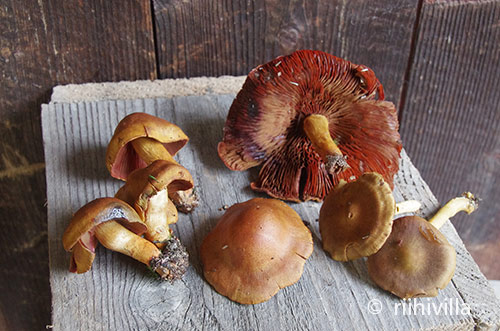
Oudommista väriseitikeistä minulla oli myös ystävältäni saatuja punasuomuseitikkejä (Cortinarius bolaris), itse en ole sitä koskaan löytänyt. Mm täällä ja täällä on siitä kuvia.
Ei tiedetä tarkkaan mitä väriaineita punasuomuseitikki sisältää, Lundmarkin sienivärjäyskirjan mukaan ne eivät kuitenkaan ole antrakinoneja kuten  Dermocybe-suvun väriseitikeillä.
Lundmarkin mukaan siitä pitäisi alunapuretuksella saada ruskeaa, toisaalta amerikkalaisen Bessetten kirja sanoo, että siitä pitäisi tulla kellanruskeaa ja purettamattomaan pinkinruskeaa.

Nyt minulla oli kuivattuja sieniä 100g, liotin ne yön yli ja keitin sieniä tunnin. Liemi oli ihan rubiininpunaista, todella hienon väristä. Annoin sienten olla liemessä ja lisäsin sinne 100g aluna (10%) -viinikivipuretettua (5%) lankaa ja värjäsin tunnin. Samaan liemeen laitoin mallipätkät purettamattomasta langasta, sekä langoista, jotka oli värjätty ilman puretusta tammenkuorilla ja toinen raparperinlehdillä ( 4 x tuoreita lehtiä suhteessa langan painoon, värjätty 15.6.2012) eli ns tammenkuoripuretus ja raparperipuretus.
Pettymyksekseni väristä tuli kellanruskeaa, ei ollenkaan mitään hienoa tummanruskeaa, kuten vaikkapa oli saatu täällä. Purettamattomassa ja tammenkuorilangassa punertava väri tuli esille, mutta hyvin heikkona.
Koska liemi näytti edelleen hyvin vahvan punaiselta, värjäsin sillä vielä kaksi jälkiväriä, joista tuli vähemmän keltaisia kuin ensimmäisestä, mutta siltikään punainen tai ruskea väri ei tarttunut lankoihin.
Vaikka käytin kaksi kertaa enemmän sieniä, mitä Lundmarkin kirjassa, niin väristä tuli vaaleampi. Ehkäpä tämä väri tarttuisi paremmin teollisiin superwash-käisteltyihin lankoihin. Eli tämän kokemuksen jälkeenen ole kovin innostunut tästä sienestä, varsinkin kun se ei ole kovin yleinenkään. Muilla seitikeillä saa samoilla suhteilla paljon voimakkaampia värejä. Toisaalta olisi kyllä mielenkiintoista tietää mitä väriaineita liemessä olevat punaiset ovat ja miten ne saisi tarttumaan lankaan!
1. esipuretus aluna-viinikivi
2. purettamaton
3. ns. tammenkuoripuretus
4. ns. raparperinlehtipuretus
5. 1. jälkiväri, esipuretus aluna-viinikivi
6. 2. jälkiväri, esipuretus aluna- viinikivi

IN ENGLISH
My friend had found me some Cortinarius bolaris mushrooms to try for dyeing. I have never found it, but here and here are pictures of it and here in English.
According to Swedish Lundmark's mushroom dye book, the dyestuffs in this mushrooms are unknown, they are not anthraquinones like in dye mushrooms belonging to Dermocybe group..
Lundmark says that this mushroom gives brown with alum, Bessette's book says it give yellow-brown with alum and pinkish brown with no mordant.

I had now 100grams of dry mushrooms, I soaked them overnight, then boiled them for one hour. The bath was really brilliant rubin red, so it looked promising. After cooling I left the mushrooms in the bath and added 100grams of wool mordanted with alum (10%) and Cream of Tartar (5%). I also added small pieces of unmordanted wool, and wool dyed with oak bark (no mordant) and another dyed with rhubarb leaves (no mordant), 4 times the rhubarb leaves to the weight of the wool, dyed June 15th 2012.

After dyeing one hour to my disappointment, the color on alum mordanted wool was not dark brown, like here, but instead dull yellow-brown. On unmordanted and oak bark "mordanted" wool the reds in the bath showed, but only very pale. Because the bath still looked bright dark red, I dyed two after colors. Even though I used twice as much dried mushrooms as Lundmark's books say, I still got paler colors than in her book. Perhaps these colors attach better on industrial superwash treated yarns, like some colors do. So after this experience I'm not so excited about this mushroom, especially when it is not so abundant here. I get much better colors with other Cortinarius mushrooms. On the other hand it would be interesting to know what are the dyestuffs in the red bath, and how to get them to attach to the wool.
Samples in the picture:
1. Premordanted with alum and Cream of Tartar
2. unmordanted
3. "oak-bark -mordanted"
4. "rhubarb leaf-mordanted"
5. 1st after bath, premordant alum and Cream of Tartar
6. 2nd after bath, premordant alum and Cream of Tartar

Saturday, March 30, 2013

Dyeing with Cortinarius purpureus Värjäys hurmeseitikillä


Seuraava sienivärjäys kuivatuilla sienillä oli hurmeseitikeillä (Cortinarius purpureus, syn Cortinarius phoeniceus).
Hurmeseitikki on hyvin samanoloinen sieni kuin verihelttaseitikkikin, mutta hiukan harvinaisempi. Se kasvaa rehevissä havumetsissä, rehevimmillä paikoilla nähtävästi kuin verihelttaseitikki, ja mm nämä sienet kasvoivat vanhan muurahaispesän ympärillä, minne oli kertynyt paksu kerros havuneulaskariketta.

IN ENGLISH
Next I dyed with dried Cortinarius purpureus (syn. Cortinarius phoeniceus).
It is very similar looking webcap as more common Cortinarius semisanguineus, and grows here in rich spruce forests. Apparently it craves more rich soil than C.semisanguineus, and the mushrooms in these pictures were growing around an old and big anthill, where there was a thick layer of needles on the ground.


Hurmeseitikki on yleensä isokokoinen, paksumaltoinen ja tukevamman oloinen kuin verihelttaseitikki. Vaikutelma tulee siitä, että sen jalka on paksumpi ja lyhyempi suhteessa lakkiin kuin verihelttaseitikin jalka. Yllä ja alapuolella olevissa kuvissa oikeassa reunassa on vertailuksi kaksi verihelttaseitikkiä ja erot jaloissa näkyvät selvästi. Myös lakin värityksessä on usein eroa. Tärkein ero on kuitenkin yleishabituksen lisäksi jalassa: verihelttaseitikin jalka on vaalean keltainen, sillä on vain jalan tyvessä punaista, kun taas hurmeseitikin koko jalassa on punaista häivemäistä seittiä, mikä tekee jalasta punertavamman näköisen.
Näiden sienten kanssa erot ovat suhteellisia, ja ennenkuin on löytänyt hurmeseitikkiä, sitä katsoo jokaista seitikkiä, että onkohan tämä nyt se, mutta kun sitten löytää oikean hurmeseitikin, niin kyllä sen heti erottaa verihelttaseitikeistä, ja sen jälkeen erottaminen on helpompaa:).

IN ENGLISH
Cortinarius purpureus is usually big webcap, and it has thick flesh and looks sturdier than C.semisanguineus. Sturdy impression comes from shorter and thicker stem in C.purpureus compared to the stem of C.semisanguineus. In the pictures above and below there are two C.semisanguineus  on the right , and you can see the difference in the stems. Also the color of the cap may be different. The most important difference, added to the over all habitus, is the stem. C.semisanguineus stem is slim, pale yellow with red velum only at the base of the stem, while C.purpureus has web-like red on the whole stem, which gives it redder impression.
These differences are relative, so they are difficult when you haven't yet found both of these mushroom, but when you find C.purpureus for the first time, you can immediately see, that it is something else than C.semisanguineus:).


Hurmeseitikin väriaineet ovat pääasiassa punaisia, dermocybiiniä ja sen glukosideja, ja siksi  sillä värjätessä jälkiväristä ei tulekaan sellaista oranssia tai keltaista kuin muilla tavallisilla seitikeillä tai veriseitikillä. Toisaalta Lundmarkin kirja sanoo, että erityisesti hurmeseitikin jälkiväreillä valonkesto on huonompi kuin muiden seitikkien väreillä. Tästä syystä käytinkin nyt aika paljon sieniä suhteessa lankaan eli 100g kuivattuja sieniä sataa grammaa lankaa kohti. Sieniä oli liotettu yön yli, haudutettu tunti ja sitten lisäsin jäähtyneeseen väriliemeen alunalla ja viinikivellä esipuretetut langat. Sienet olivat samassa liemessä koko värjäyksen ajan, ja tästä syystä väristä tuli hiukan epätasaista, mutta varsinkin ensimmäinen karmiininpunainen on ihan hieno väri. Nyt vaan pitää sitten odottaa taas uutta hyvää seitikkivuotta.

IN ENGLISH
The dyestuffs in Cortinarius purpureus are mainly reds, dermocybin and it's glucosides, and that is why the after bath of C.purpureus from less orange or yellow than when dyeing with other webcaps. On the other hand Swedish Lundmarks's book says that particularly the after baths from this mushroom are not as lightfast as the after baths from other Cortinarius mushrooms. 
That is why I used now a lot of mushrooms: 100g of dried C.purpureus to 100grams of yarn. I soaked the mushroom over night, then simmered for one hour, and after cooling the bath, added the mordanted fiber. The mushrooms were in the same bath with the fiber during the dyeing, and this is why the color is slightly uneven (the parts of the fiber which touched the mushrooms got more color), but I think the darker color from the first bath is really nice. Now I have to wait for the next good mushroom autumn to get more of these.

Thursday, March 28, 2013

Dyeing with Cortinarius malicorius Värjäys tulihelttaseitikillä


Tulihelttaseitikki (Cortinarius malicorius) on pieni, selvästi verihelttaseitikkiä pienempi sieni (lakin halkaisija n 5cm), jolla on oranssit heltat. Eniten se muistuttaa pikaisesti katsoen ainakin täälläpäin yleistä kaneliseitikkiä (Cortinarius cinnamomeus) tai harvinaisempaa sahramiseitikkiä (Cortinarius sommerfeltii), mutta on helpointa erottaa näistä tummasta oliivinvihreästä jalan mallosta. Ruotsiksi tulihelttaseitikin nimi onkin Grönköttig spindling eli vihreämaltoinen seitikki. Tulihelttaseitikki kasvaa rehevissä kuusimetsissä, kun taas kaneliseitikkiä on yleisimmin karuissa kalliomänniköissä.

Sienivärjäyksessä tulihelttaseitikki on oikein hyvä värisieni, ja se sisältää enemmän keltaisia antrakinoneja kuin punaisia. Lundmarkin kirjan mukaan myös tulihelttaseitikin jälkivärit ovat kestävämpiä kuin yleensä seitikkien jälkivärit. Sen antama väri on kirkkaampi kuin mitä olen saanut kaneliseitikeillä, mutta monesti on helpointa laittaa kaikki oranssihelttaiset pikkuseitikit samaan pataan ja silloin väristä tulee kuitenkin jonkinlaista oranssia. Jos tulihelttaseitikkiä löytää tarpeeksi, se kyllä kannattaa kuivata ja värjätä sillä erikseen. Keltahelttaiset pikkuseitikit kannattaa pitää erillään oranssihelttaisista.
Meilläpäin tulihelttaseitikkiä ei kasva paljoa, olen löytänyt sitä vain muutaman kerran yksittäisiä sieniä, mutta sain sieniä harrastavalta ystävältäni  ison pussillisen kuivattuja tulihelttaseitikkejä, ja  värjäsin niillä nyt ylläolevat värit, joista tulikin juuri oikeat sävyt oranssiin Tulppaani -lapaspakettiin:)

Liotin kuivattuja sieniä yön yli, haudutin hiljaa poristen tunnin ja siivilöin liemen. Yhtä hyvin sienet olisi voinut jättää väriliemeen värjäyksen ajaksi.
Käytin 70g kuivattuja sieniä/100g lankaa. Käytän mielummin liian paljon kuin liian vähän sieniä, jotta ensimmäisestä väristä tulee tarpeeksi voimakas.
Langat oli esipuretettu alunalla (10%) ja viinikivellä (5%) ja tunnin värjäyksen jälkeen tuli kuvan ylempää tummempaa väriä, alempi väri tuli jälkivärjäyksestä.

IN ENGLISH
Cortinarius malicorius is a small dye mushroom (the cap is about 5 cm wide), which has orange gills. It can be mixed with Cortinarius cinnamomeus which is more common, or Cortinarius sommerfeltii, which is more rare here, but C.malicorius is easiest to identify from the other two by it's dark olive green flesh in the stem (outside the stem is yellow, it is the flesh inside which is olive green). The Swedish name for this mushroom is Grönköttig spindling which means green-flesh webcap. The Finnish name for this mushroom is tulihelttaseitikki which means fire-gilled webcap.
Cortinarius malicorius grows here in rich spruce forests among moss, while Cortinarius cinnamomeus grows more with pines in sandy or rocky ground.
You can read about it also in Mushroomexpert-pages.

Cortinarius malicorius is a very good dye mushroom, and it contains more yellow anthraquinones than red ones. According to Swedish Hjördis Lundmark's dye book, also the after baths from C.malicorius are more lightfast than after baths from many other mushrooms. The color is gives to wool is brighter than what I have gotten from Cortinarius cinnamomeus, but many times it is easiest to put all these different orange gilled webcaps in the same dyepot, and it is likely that you get some kind of orange anyway. Though if you find enough of C.malicorius, it is better to dye with it alone. All yellow gilled webcaps are better to keep separate from these orange gilled ones. 
In the forests around my house C.malicorius is not common, I have found it only a couple of times, but I got a large bag of dried mushrooms from a friend who is a mushroom expert and lives norther. I dyed the above colors with her mushrooms, and gave just the right colors for my orange Tulips mitten kits:)

I soaked the dried mushrooms over night, simmered them for one hour and strained the dye bath. I could have left the mushrooms in the bath also. 
I used 70grams of dried mushroom to 100grams of yarn. I like to use rather too much than too little mushrooms, so that the first color will be deep enough. 
The yarn was pre mordanted  with alum (10%) and cream of tartar (5%), and after dyeing for one hour I got the darker orange in the picture. The lighter color below came from the after bath.

Friday, March 22, 2013

Winter work Talvipuuhia


Talvi vaan jatkuu, vaikka on jo kohta maaliskuun loppu. Olen kylvänyt sisälle jo tomaatteja, yrttejä ja esikoita, mutta värikasvien kylvöt odottavat  ensi viikkoon. Kun ulkona ei pysty vielä tekemään puutarhatöitä, niin olen alkanut värjätä pois aika isoa kuivattujen värisienten varastoani. Suurin osa on verihelttaseitikkejä, mutta kaikenlaista muutakin on, niistä sitten lisää sitä mukaa kun saan värjättyä niillä. Kesäksi tarvitaan paljon lankaa torille, ja nyt on hyvää aikaa valmistautua siihen. Myös puretuksia on hyvä tehdä nyt valmiiksi, näin langat ehtivät asettua kunnolla ennen kesän värjäyksiä. Ja toria varten pitää neuloa kaikenlaista jotta kesällä olisi tarpeeksi myytävää.

Tavallisesti tähän aikaan näkyy jo ensimmäisiä lumikelloja, nyt ei, ja niiden puutteessa olen tehnyt uusia lumikellolapasia:) Kolmien lapasten tekemisen jälkeen (ja useiden purkamisten), on malli nyt aika lailla mieleiseni, mutta värien kanssa on vielä vähän jahkaamista. Uskoisin näiden kyllä kumminkin valmistuvan tarvikepaketiksi huhtikuun aikana.

IN ENGLISH
It is still winter over here, even in south of Finland, and it is almost end of March already. I have sown tomatoes, herbs and some primulas inside, but not yet any dye plants, I think I will sow first of them next week, before Easter. Before the snow melts and gardening season starts  I have begun to dye with my big stash of dried dye mushrooms. Most of them are Cortinarius semisanguineus, but I have smaller amount of many other mushrooms, too. More about them when I have something to show. This is also a good time to mordant yarn for the summer dyeings, this way the mordanting has time to cure before summer. I need a lot of yarn, kits, mittens and hats for the market in the summer, and now is the time to dye the yarns and knit so that I have enough to sell in the summer.

Usually at this time of year my first snowdrops are flowering (or at least peaking from the ground), but not this year. I was so much missing them and so I started to design and knit snowdrop-mittens:) After knitting three pairs ( and after frogging several times) I now think my design is how I want it to be, but I'm still hesitating between colors, and I need to knit at least one more pair to compare. But I believe I will have them ready to show and as a kit during April.


My knitting basket today.

Sunday, March 10, 2013

Lichens on the snow Jäkäliä lumella


Pihatiellä olevissa tammissa on paljon jäkäliä. Viime viikolla yhtenä aamuna käpytikat olivat olleet kaivelemassa oksia ja tiputelleet paljon jäkäliä tielle. Myös kovat tuulet usein tiputtelevat jäkäliä ja myrskyjen jälkeen niitä kannattaa etsiä tieltä värjäystä varten. Jäkälät uusiutuvat hitaasti enkä kerää niitä koskaan puista, mutta tielle tippuneita kerään, samoin kun kaadetaan puita polttopuiksi niin jäkälät kannattaa ottaa mielummin värjäykseen kuin laittaa ne puuhellaan.

IN ENGLISH
In the old oaks by the small road to our house there are lots of lichens. One morning last week the woodpeckers had been in the oaks trying to find food from the crevices of the bark and in the process lot of lichens had fallen off the trees to the road. Many times also after storms you can find fallen lichens. Lichens grow back very slowly, and gathering them from where they are growing is not recommended, but fallen lichens like these, or the ones from felled trees, can be used in small amounts in places where they are abundant.


Nämä meidän tammissamme kasvavat jäkälät ovat pääosin yleisiä paisukarvejäkäliä (Hypogymnia physodes) ja  harmaaröyhelöä (Platismatia glauca), joilla molemmilla voi  värjätä villalle keltaisia ja ruskeita värejä ilman muuta puretusta.

IN ENGLISH
These lichens in our trees are mostly here very common species Hypogumnia physoides and Platismatia glauca. They both give fast yellow, brown and orange colors to wool without any additional mordant.


Ja lunta vielä riittää.

And as you can see, still a lot of snow.


Isoin jäkälä yllä olevassa kuvassa on harmaahankakarve (Pseudevernia furfuracea). Käytän näitäkin värjäykseen tavallisella keittomenetelmällä muiden seassa, koska omat kokemukseni ammonialla saaduista  pinkeistä/punavioleteista eivät ole kestävyyden suhteen kovinkaan hyviä (tosin lisäkokeiluja tarvitaan pidempien käymisaikojen suhteen, ne voivat EHKÄ parantaa kestävyyttä). Kellanruskeat ja oranssit sen sijaan ovat kestäviä. Tosin keltaisia värjä saa helposti monista yleisistä kasveista, joten jäkäliä ei värjäystä varten tarvitse kerätä, ellei niitä satu sopivasti tulemaan vastaan, kuten näistä puistani.
Jäkälät eivät ole kovin helppoja tunnistaa, enkä itsekään tunne kuin aivan yleisimpiä lähistöllä kasvavia. Netistä kuvia löytyy mm Valokki - nettikasvio sivuilta ja Pinkka sivuilta. Mikäli jokin jäkälä näyttää erikoiselta ja oudolta, se on luultavasti harvinainen ja kannattaa jättää keräämättä.

IN ENGLISH
The biggest lichen in the picture above is Pseudevernia furfuracea. I dye also these lichens with the usual boiling water method among other lichens, because my own experiences on the lightfastness of colors (pinks/purples) gotten from lichens with fermenting in ammonia are not so good (but I admit I would need to experiment more with longer fermenting times, longer times MAY improve the fastness). The yellows and browns are however lightfast. On the other hand you can get yellows very easily from many common plants, and using lichens for dyeing is by no means necessary. These lichens just happened to fall almost literary to my feet:).
Lichens are not very easy to identify, and I know only the most common ones around where I live. There are pictures of lichens in Finnish site Valokki. If you see a lichen which looks special or different than others nearby, the odds are that it is rare and it is better to leave it where it is.


Nyt sain tällaisen purkillisen jäkäliä, kuivaan nämä odottamaan kunnes tuuli puhaltaa lisää maahan, ja saan näitä tarpeeksi värjäystä varten.

IN ENGLISH
This is how much I got now. I will dry these and leave to wait until the wind blows more lichens down from the trees.